AGV Jacking Robot Factories & Wholesalers Serving the León Market
Factory-direct laser SLAM AMRs, jacking robots, smart forklifts, and custom top modules for León warehouses, production lines, logistics hubs, and system integrators.
8 AGV Jacking Robots & Related AMRs Recommended for León Buyers
These eight platforms cover the most common factory and warehouse requirements in the León market: rack lifting, pallet transfer, line-side replenishment, high-shelf docking, autonomous forklift work, and integrator-built mobile robot projects. Every system shares the same Marnix navigation, fleet scheduling, and charging ecosystem.

Heavy Load 2000KG Load Forklift Laser Guide AMR for Warehouse Pallet
A heavy-load laser-guided AMR for warehouse pallet movement, inbound staging, and dispatch buffering where repeatable traction and stable navigation matter.
View product
Omnidirectional Humanoid Robot Chassis Dual 7-DOF Arms Laser SLAM Autonomous Warehouse AMR Mobile Platform
An integrator-focused mobile platform that combines omnidirectional mobility, dual 7-DOF arms, and laser SLAM navigation for advanced warehouse and service tasks.
View product
Customizable 1500KG Traction Capacity AGV Autonomous Mobile Robot Amr with Lidar Guided Sensor
A customizable traction platform for cart trains, towed containers, and flexible material movement across mixed production and warehouse zones.
View product
Automatic Handling CE Certificate 2000kg Forklift Robot Vehicle Laser AGV for Large Load Goods-carrying
A large-load autonomous forklift robot for goods-carrying tasks where a CE-compliant configuration and project-specific documentation are required.
View product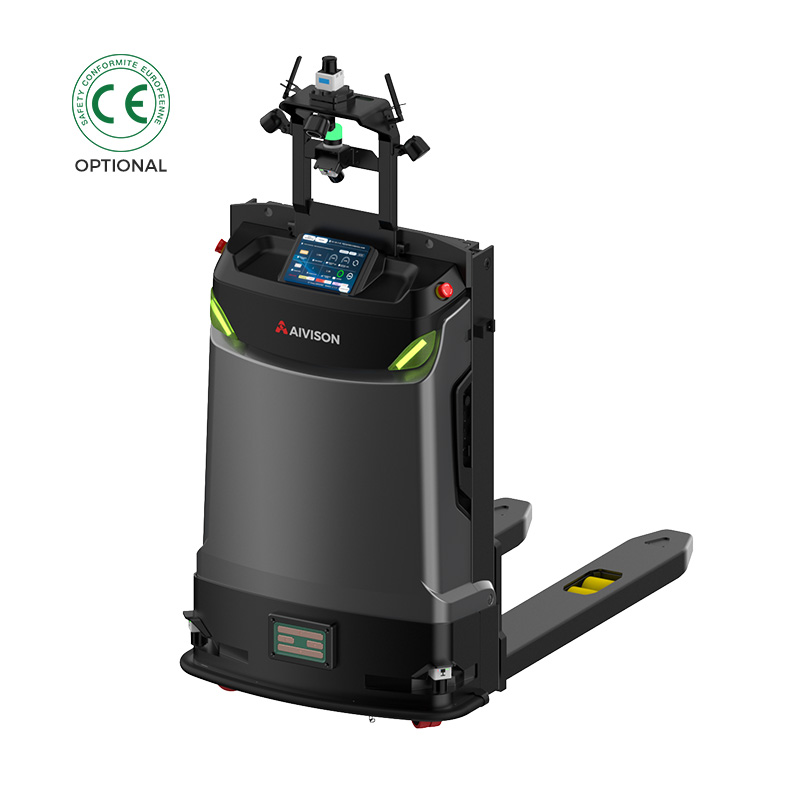
AGV AMR Warehouse Automatic Guided Vehicle 1500kg 2000kg AGV Robot Forklift
A warehouse workhorse for 1.5–2 t pallet transfer, designed for repetitive movement between receiving, storage, and outbound staging areas.
View product
Omnidirectional Service Humanoid Robot Chassis Dual 7-DOF Arms Laser SLAM Navigation for Hospitality and Retail
A service and retail automation platform for integrators that need humanoid mobility, dual arms, and laser SLAM navigation in public-facing environments.
View product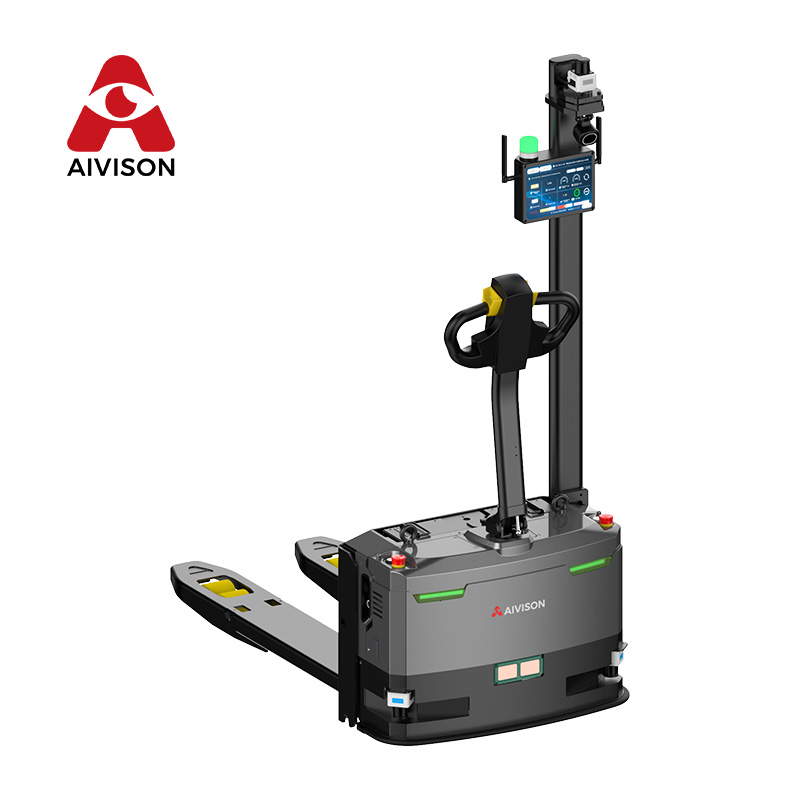
Aivison Stacker Truck Pallet Stacker Forklift Agv 1.5 Ton Autonomous Forklift Smart Deliver AMR Robot
A stacker-style autonomous forklift for compact pallet handling, stacking, and smart delivery in warehouses with tighter maneuvering space.
View product
Hot Selling Logistics Navigation Detector Sensor Lidar Manufacturers Direct Sales
A lidar navigation sensor option for logistics automation projects, system integrators, and mobile robot builds that require direct factory sourcing.
View productYears in AGV Engineering
About a decade of mobile robot R&D and manufacturing experience.
Laser SLAM Accuracy
No magnetic tape, reflectors, or floor QR codes for standard navigation.
Manufacturers Served
Deployments across three continents, including Fortune 500 supplier projects.
Core Industries
Semiconductor, 3C, lithium battery, PV, automotive, PCB, textile, and medical.
What León Buyers Should Know Before Sourcing an AGV Jacking Robot
An AGV jacking robot is not simply a forklift without a driver. It is a low-profile mobile platform that drives under a rack, cart, or pallet stand, lifts the load, and moves it without forks entering the pallet. That distinction changes the layout study, the precision strategy, and the total cost of ownership.
In the León market, factories and warehouses often operate with mixed racking, manual carts, tight aisle widths, and existing Wi-Fi coverage. The strongest automation projects start by identifying the one or two moves that constrain throughput—not by replacing every pallet truck at once. A factory-direct supplier should help you separate a line-side replenishment task from a high-shelf docking task, because they require different precision levels and different top modules.
Trackless navigation first
Laser SLAM maps natural features and reaches ±5 mm without floor tracks. QR labels are added only where a station needs ±2 mm docking precision. This is the most cost-effective way to avoid floor rework in an operating León plant.
Fleet coordination by Wi-Fi
Multiple robots are coordinated by an intelligent scheduling system over indoor Wi-Fi. Task assignment, traffic control, and automatic charging can be planned together, so a pilot cell can grow into a full fleet without changing the navigation core.
Top module fit matters
Jacking units, roller conveyors, forklift forks, and 6-axis arms solve different handover problems. A manufacturer that can customize the chassis and top module usually reduces integration risk compared with a wholesaler that only resells a standard catalogue unit.
Why León Factories and Wholesale Buyers Work With Marnix
Shenzhen Marnix Intelligent Technology Co., Ltd. is a mobile robot manufacturer with about ten years of AGV engineering experience. The company builds laser SLAM autonomous mobile robots, jacking robots, smart forklifts, composite mobile robots, and intelligent charging docks for factories and system integrators. For León buyers, the practical value is not a catalogue claim; it is the ability to match payload, floor layout, docking precision, safety scope, and top module before the robot is shipped.
The portfolio is designed around a shared navigation and fleet-software core. That means a jacking robot, a pallet AMR, and a smart forklift can be evaluated as one automation roadmap rather than disconnected purchases. When a León project grows from one line-side route into a multi-zone deployment, the same scheduling logic can support traffic control, task assignment, and automatic charging.
- Factory-direct customization of chassis, payload, jacking unit, roller conveyor, forks, and robotic arm modules.
- ±5 mm laser SLAM standard navigation, ±2 mm with QR assist, and ±0.05 mm repeatability for composite arm platforms.
- Multi-stage intelligent inspection and operational stress testing before shipment.
- Verified supplier evidence: TÜV Rheinland onsite assessment, Fortune 500 supplier contract, 200+ manufacturers served.
- Support for end users and system integrators, including project documentation and export packing.

Manufacturer-level engineering
Custom top mechanisms are designed around real production interfaces instead of forcing a standard chassis into an incompatible process.
Verified credentials
Third-party onsite assessment and trade records help procurement teams reduce supplier risk before a purchase order is issued.
QR upgrade path
Start with ±5 mm SLAM and add a QR camera only at high-precision docking points. This avoids unnecessary floor infrastructure costs.
Composite robot depth
AMR mobility can be combined with 6-axis arms and roller systems for multi-layer synchronization and ±0.05 mm repeatability.
Integrator-ready support
System integrators can source chassis, top modules, charging docks, and fleet software from one factory partner.
Export project discipline
Robot configuration, packing, documentation, and commissioning support are planned as one project rather than a catalogue shipment.
AGV Jacking Robot Application Scenarios in the León Market
León's industrial base rewards automation that works inside existing buildings, not only in new greenfield warehouses. The following scenarios are the most common starting points for jacking robots and related AMRs.
Automotive & auto parts
Line-side kitting, WIP rack movement, sequencing buffers, and finished-parts transfer.
- Stable takt-time replenishment
- Mixed traffic with forklifts and people
- Traceable task handover
Agri-food & cold chain
Pallet and tote movement between production, cold storage, packing, and dispatch.
- Repetitive routes across shifts
- Reduced manual push-pull strain
- Flexible re-mapping after layout changes
Logistics, 3PL & e-commerce
Cross-docking, high-shelf replenishment, returns processing, and outbound staging.
- 24/7 duty with automatic charging
- ±2 mm QR docking where needed
- Fleet scheduling for peak periods
Light manufacturing
Leather, footwear, consumer goods, electronics, and packaging operations with small racks and carts.
- Compact jacking platforms
- Reuse existing carts and racks
- Pilot one bottleneck before scaling
León buyers often begin with a single high-frequency route—raw material to line, line to buffer, or buffer to dispatch. A one-robot pilot can validate route design, Wi-Fi quality, safety behavior, and operator acceptance before a wider rollout.
León Market Trends Driving Demand for AGV Jacking Robots
Automation decisions in León are increasingly shaped by labor flexibility, existing infrastructure, energy discipline, and the need to redeploy assets across multiple sites. The winning model is modular, measurable, and easy to expand.
1. Labor availability and turnover
Repetitive pushing, pulling, lifting, and long-distance walking are increasingly difficult to staff consistently. Jacking robots absorb the non-value-added travel while operators focus on quality and exception handling.
2. Less appetite for floor rework
Operating plants cannot stop production for magnetic tape or extensive QR installation. Laser SLAM navigation maps natural features first and adds QR only where precision justifies it.
3. Flexible, multi-site supply chains
Regional supply-chain shifts reward robots that can be re-mapped and redeployed. A trackless platform is easier to move between buildings than fixed infrastructure.
4. Total cost of ownership
Buyers compare uptime, charging strategy, spare-parts access, safety documentation, and engineering support—not only the initial robot price. Factory-direct customization can reduce integration waste.
Illustrative procurement priorities for León automation projects
Composite view of common RFQ priorities; not a statistical market survey. Use it as a discussion framework with your engineering team.
How to Evaluate AGV Jacking Robot Factories & Wholesalers Serving León
Whether you buy directly from a factory or through a local wholesaler, the evaluation should be based on evidence. Ask for the engineering logic behind the proposal, not only a model number.
Load and rack audit
Confirm the maximum load, rack footprint, center of gravity, and whether the robot drives under the rack or lifts from the floor. Include the rack weight itself in the calculation.
Floor, aisle, door, and lift survey
Share CAD or a sketch with aisle widths, door clearances, slopes, floor joints, and elevator or lift interfaces. Small layout constraints often determine the chassis size.
Precision by station
Do not specify ±2 mm everywhere. Map which stations truly need QR-assisted docking and which routes can run on ±5 mm natural-feature SLAM.
Wi-Fi and fleet design
Check access-point coverage, roaming quality, and traffic control. A single robot may be enough for a pilot, but the software should support growth.
Safety and compliance documents
Request risk-assessment support, configuration-specific safety functions, and documentation for the intended market. Confirm the scope of CE, declarations, and integration responsibilities.
Spare parts and remote support
Ask how spare parts, firmware updates, and remote diagnostics are handled. A local wholesaler without factory support can slow down a critical repair.
Laser SLAM standard
No tracks, reflectors, or floor codes. Best for warehouse transfer, line-side delivery, and routes that change frequently.
SLAM + QR camera
QR labels are applied only at precision stations. Best for high-shelf storage, machine docking, and wafer-handling interfaces.
Composite robot arm
AMR mobility plus a 6-axis arm for assembly, machine tending, and medical-device tasks that require arm-level repeatability.
| Configuration | Accuracy | Floor setup | Best fit for León projects |
|---|---|---|---|
| Laser SLAM natural features | ±5 mm | None; no tape or reflectors | Warehouse transfer, line-side replenishment, changing layouts |
| SLAM + QR scanning camera | ±2 mm | QR labels only at docking points | High-shelf docking, precision handover, equipment interfacing |
| Composite AMR + 6-axis arm | ±0.05 mm | Station calibration | Semiconductor, medical device, and precision assembly support |
Factory Advantages & Evidence León Buyers Can Review
Industrial sourcing is a risk decision. Marnix supports buyers with independent assessment, trade history, engineering customization, and a product ecosystem that includes jacking robots, smart forklifts, composite mobile robots, and charging docks. The company serves end users and system integrators, so a León project can be supported either as a direct factory purchase or as part of an integrator-led automation package.
Quality control is built around multi-stage intelligent inspections and operational stress tests before shipment. For projects that require a composite robot, multi-layer synchronization protocols help connect the mobile chassis, arm, and production equipment with repeatable handover behavior. These are the details that determine whether a robot becomes a reliable asset or a maintenance burden.

TÜV Rheinland Onsite Assessment
Independent inspection of company premises and operations can be reviewed before purchase.
View reportSupplier to Fortune 500
Procurement contract with a Fortune 500 company, supported by independent third-party assessment.
Trade history200+ Manufacturers Served
Deployments across three continents in semiconductor, 3C, lithium battery, PV, automotive, PCB, textile, and medical sectors.
Verified Multispecialty Supplier
Low-MOQ customization and multi-category mobile robot procurement capability for integrators and end users.
Trade capacityFrequently Asked Questions from León Buyers
Direct answers for procurement teams, plant engineers, and system integrators comparing AGV jacking robot factories and wholesalers for the León market.
Can Marnix supply an AGV jacking robot directly to León?
Yes. Marnix serves the León market as a factory-direct manufacturer and wholesale supplier from Shenzhen, China. Please share the exact delivery postcode, because logistics planning differs for León, Spain and León, Guanajuato, Mexico. The export team can prepare a configuration, packing plan, and shipping quotation for the destination, with integration support coordinated for the project.
Do I need to modify the factory floor or install magnetic tape?
No for standard laser SLAM navigation. The robot maps natural features and reaches ±5 mm without magnetic tape, reflectors, or floor QR codes. QR labels are only added at stations that require ±2 mm docking precision. A floor survey is still important to check slopes, joints, aisle widths, and rack clearances before final selection.
What payload and rack height can a jacking robot handle?
Payload depends on the chassis, lifting unit, rack design, center of gravity, and required speed. The product range includes platforms in the 300 kg, 1.5 t, and 2 t classes, plus smart forklifts for larger loads. Send the loaded rack weight, rack footprint, lifting height, and floor conditions so the factory can recommend the correct configuration instead of over-specifying.
How many robots do I need for a León warehouse or production line?
Fleet size is set by mission frequency, travel distance, congestion, charging time, and peak throughput. Many León projects start with one robot on a bottleneck route, measure the actual cycle time, and then scale. The Marnix fleet scheduling system can coordinate multiple robots over indoor Wi-Fi with traffic control and automatic charging.
Can the robot integrate with our WMS, MES, or production equipment?
Integration scope should be defined during the project evaluation. Marnix supports integrators with mobile robot platforms, top modules, fleet scheduling, and charging docks. Depending on the project, the robot can be connected to conveyors, machines, or shelving through custom top modules. Interface responsibilities should be agreed between the end user, integrator, and factory before commissioning.
What safety documentation is available?
Safety functions and documentation are configuration-specific. Buyers should request a risk-assessment discussion, confirm the intended operating environment, and clarify which declarations or compliance documents are needed for the final system. This is especially important when robots share space with people, forklifts, and manual carts in an existing León facility.
What is the typical project process?
A practical process is: requirement review, layout and load study, navigation precision mapping, proposal, factory configuration, production, testing, export packing, shipping, site integration, and operator training. Custom top modules may add engineering time. Sharing your throughput target and layout drawing early is the fastest way to shorten the evaluation cycle.
What should we send to receive a catalogue and recommendation?
Send the loaded weight, rack or cart dimensions, aisle width, lift height, docking precision by station, required throughput, existing Wi-Fi coverage, destination postcode, and whether the project will be managed by an end user or system integrator. With those inputs, Marnix can recommend a jacking robot, smart forklift, or composite platform and provide the relevant catalogue content.
Get a León-Ready AGV Jacking Robot Recommendation
Share your load profile, layout drawing, throughput target, docking precision, and delivery postcode. The factory team will map the right jacking robot, AMR, smart forklift, or composite platform to your material flow.
Get Catalog Factory: Shenzhen Marnix Intelligent Technology Co., Ltd. · info@marnixbot.com