Top China Industrial Transport Robot Factories & Wholesaler
A factory-led procurement guide to laser SLAM AMRs, jacking robots, smart forklifts, pallet movers and custom mobile platforms—engineered for factories, warehouses and system integrators that cannot afford unstable material flow.
8 Industrial Transport Robots for Factory, Warehouse and Integrator Projects
These eight platforms cover 300 kg light pallet movement, 800 kg stacker handling, 1,500 kg traction towing, 2,000 kg laser forklifts, humanoid robot chassis development and high-precision servo control. Product URLs are preserved below so buyers can review exact specifications, then request a factory configuration matched to aisle width, load profile and docking accuracy.

Customizable 1500KG Traction Capacity AGV AMR with Lidar Guided Sensor
A heavy-duty towing platform for mobile racks, carts and large subassemblies. Laser SLAM navigation removes fixed tape and reflectors, making it suitable for routes that change as production layouts evolve.
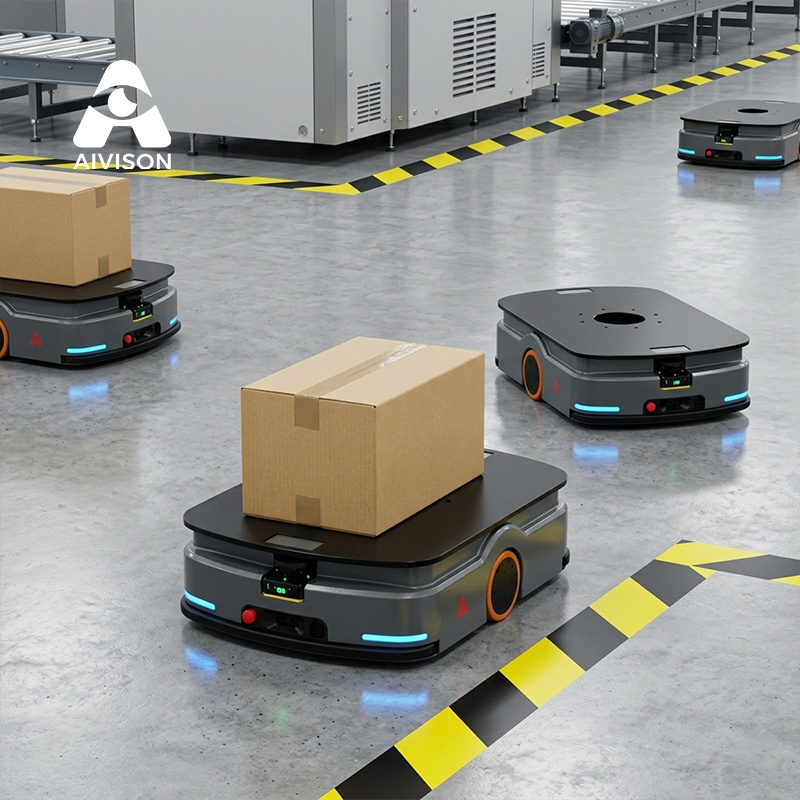
Autonomous Mobile AMR Robot 300kg Payload Laser Guided AGV
A compact 300 kg payload AMR for 3C electronics, small-parts assembly and narrow-aisle transport. It is a practical entry platform when a full forklift-class robot would be oversized.
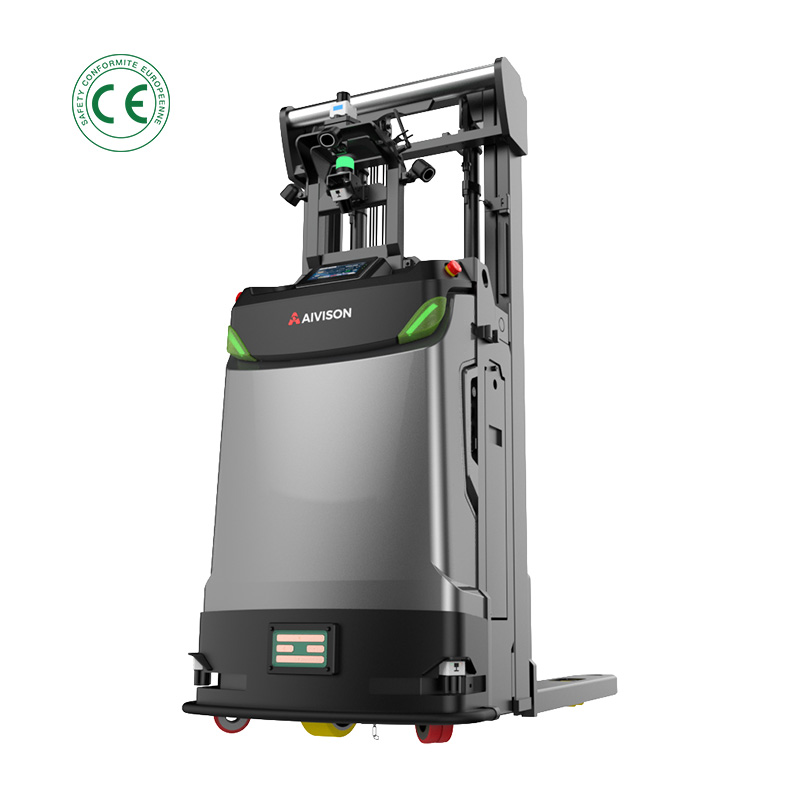
Smart Transport Robotic with Laser Navigation Reach 2000KG AGV
A 2,000 kg laser-navigation platform for warehouse and logistics transport. The heavier payload class supports pallet-scale flows while keeping trackless route flexibility.

Warehouse Stacker CE Forklift AGV 800kg Load Capacity AMR Pallet
An 800 kg pallet stacker AGV for light pallet handling, low-height racking and space-constrained storage zones. It is designed for buyers who need automated lifting without a large counterbalance footprint.

Omnidirectional Humanoid Robot Chassis Dual 7-DOF Arms
A development-ready humanoid AMR platform combining omnidirectional mobility, dual 7-DOF arms and laser SLAM. It is suited to integrators building manipulation, inspection or service applications.

Omnidirectional Service Humanoid Robot Chassis Dual 7-DOF Arms
A dual-arm humanoid chassis for hospitality and retail applications. Integrators can add application software, sensors and interaction modules on top of a proven mobile base.
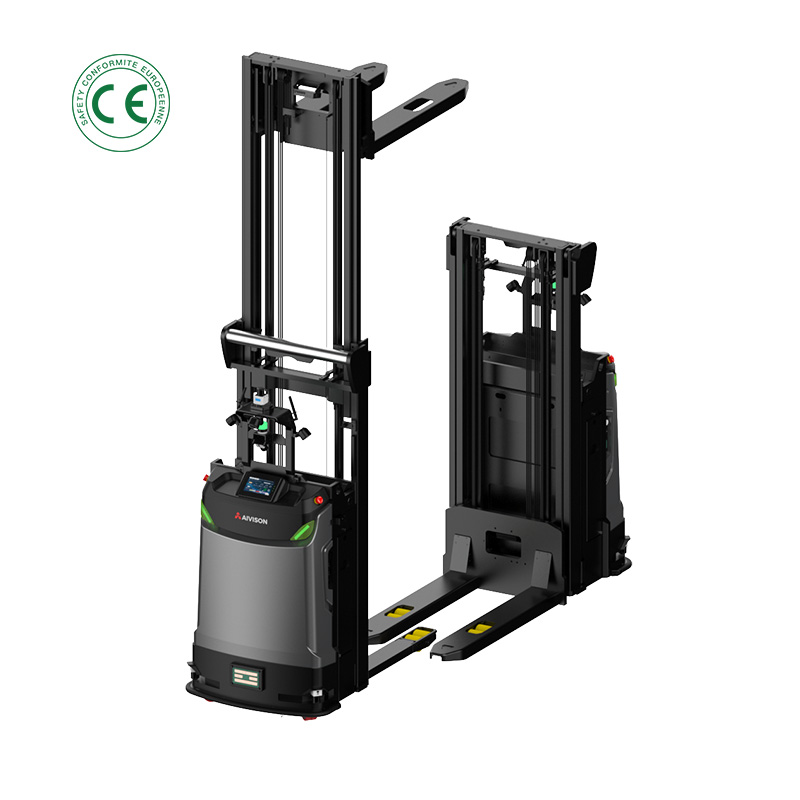
Factory AMR Robot Laser 2000kg Forklift AGV
A 2,000 kg laser forklift AGV for moving pallets between storage, line-side buffers and shipping zones. It is designed for mixed-traffic factories that need repeatable pallet handling.
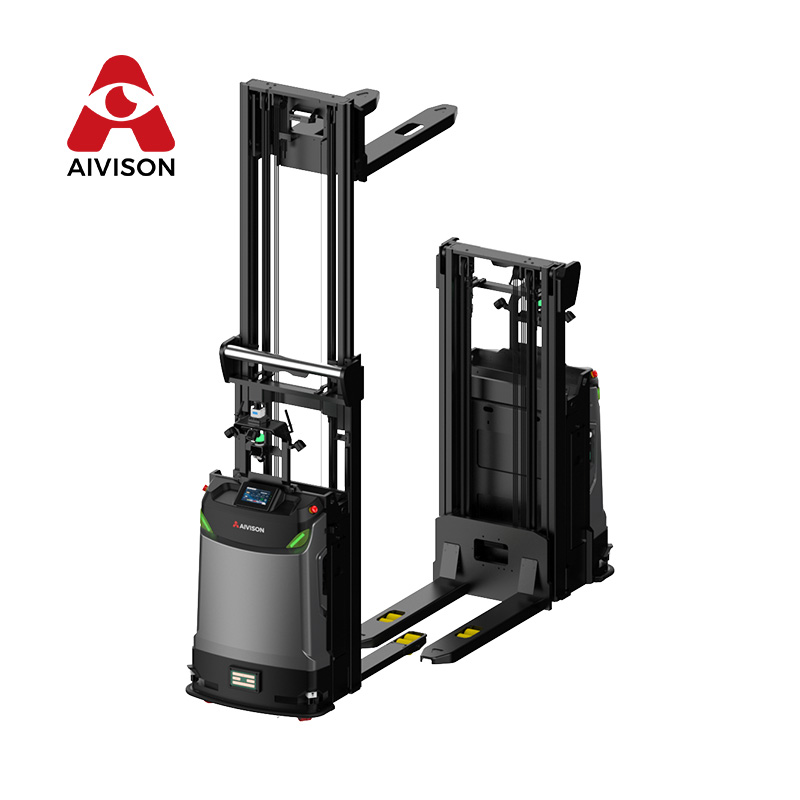
High Precision AGV Forklift Full Servo Motor Controlled 2000kg
A full-servo 2,000 kg laser forklift for applications where fork engagement, motion smoothness and positioning stability matter. It suits precision pallet docking and heavy-load line-side delivery.
Need a different payload, top module or navigation accuracy?
Inquire NowWhat Separates a Top China Industrial Transport Robot Factory from a Reseller
In China’s AMR and AGV market, the same product category may be sold by a factory, a trading company, a system integrator or an online wholesaler. The commercial difference matters because industrial transport robots are not finished consumer goods. They are engineered systems involving chassis design, navigation, safety, top modules, fleet scheduling, charging strategy and after-sales support.
A factory-led supplier can control the quality of the mobile platform, the navigation stack, the lifting or fork mechanism, the final assembly and the pre-shipment test. A reseller may only pass along a specification sheet. For procurement teams, the most reliable evaluation path is to request factory evidence, test records, customization boundaries and a clear explanation of what is standardized versus engineered to order.
Shenzhen Marnix Intelligent Technology Co., Ltd. represents the factory-led model. Drawing on about ten years of AGV engineering experience, the company builds laser SLAM AMRs, jacking robots, smart forklifts, pallet AMRs, composite mobile robots, humanoid chassis platforms and intelligent charging docks. Its robots are used by more than 200 manufacturers across three continents, and the company has been assessed onsite by TÜV Rheinland. Those credentials do not replace a project-specific validation, but they give buyers a stronger starting point than an unverified catalog.
- Manufacturing evidence: ask for factory process, assembly photos, testing routines and third-party assessment records.
- Customization depth: confirm whether top modules, payload, chassis and interfaces are engineered in-house or only sourced externally.
- Navigation accountability: the supplier should explain when ±5 mm laser SLAM is sufficient and when QR assist or arm-level precision is required.

Match the Robot Platform to the Real Material Flow
Most avoidable AMR project risks begin with mismatch: a robot is selected by headline payload instead of aisle width, docking tolerance, load center, fleet throughput and handover equipment. Use the matrix below as a starting point for an RFQ.
| Requirement | Recommended platform | Navigation and precision | Best-fit scenario |
|---|---|---|---|
| Light pallet or small load transport | 300 kg AMR or 800 kg pallet stacker | Laser SLAM ±5 mm; QR optional ±2 mm | 3C electronics, small-parts assembly, narrow aisles and low-height racking |
| Cart, rack or towed load movement | 1,500 kg traction AGV AMR | Lidar-guided SLAM with dynamic avoidance | Automotive parts, lithium battery lines, mobile racks and changing layouts |
| Heavy pallet handling | 2,000 kg laser forklift AGV | Laser navigation; vision or QR assist as needed | Warehouse dispatch, line-side buffers, shipping zones and mixed traffic |
| Precision pallet docking | High-precision servo laser forklift | Servo-controlled motion with repeatable positioning | Applications where fork entry and load stability are critical |
| Composite manipulation or service robotics | Humanoid chassis or AMR with 6-axis arm | Laser SLAM plus arm repeatability to ±0.05 mm | Semiconductor, medical devices, inspection, hospitality and retail platforms |
Future Buying Trends for Industrial Transport Robots
Procurement is moving away from isolated robot purchases toward repeatable fleet programs. The winning suppliers will be those that can document total cost of ownership, support mixed fleets and provide modular growth paths.
Total Cost of Ownership Beats Sticker Price
Buyers increasingly compare floor modification, installation downtime, spare parts, charging efficiency and fleet software over a multi-year horizon. A robot that avoids magnetic tape and reflectors can reduce civil works, but the supplier should also show how charging docks and scheduling affect uptime.
Mixed Fleets and Open Interfaces
Factories rarely automate with one robot type. They need jacking robots, forklifts and pallet AMRs to cooperate under one scheduling layer. Procurement teams now ask how robots communicate over indoor Wi-Fi, how tasks are assigned, and whether future third-party equipment can interface through standard protocols.
Modular Top Modules Become Standard
The mobile chassis is becoming a reusable asset. Buyers prefer suppliers that can add jacking units, roller conveyors, forklift forks or robotic arms without redesigning the entire platform. This modularity protects capital investment when production processes change.
Precision Is Purchased by Station
Not every station needs millimeter precision. Smart buyers specify ±5 mm laser SLAM for general transport, ±2 mm QR-assisted docking only where needed, and ±0.05 mm composite repeatability for robotic manipulation. This tiered approach avoids unnecessary infrastructure cost.
Safety and Verification Evidence
Industrial buyers are asking for more than a datasheet. They want evidence of mixed-traffic testing, quality inspection routines and third-party verification. Marnix’s TÜV Rheinland onsite assessment and Fortune 500 supplier record are examples of the documentation trail that increasingly supports supplier shortlisting.
Wholesaler and Integrator Partnerships
System integrators and regional wholesalers need a manufacturing partner that can supply multiple robot categories, support customization and keep documentation consistent. The next phase of China sourcing is not only product price, but repeatable technical support for multi-project pipelines.
Where Industrial Transport Robots Are Heading Next
From Fixed Guidance to Natural-Feature SLAM
Laser SLAM on natural features is replacing tape, reflectors and dense floor codes for general transport. The operational benefit is layout flexibility: routes can be re-mapped when racks move, aisles are reorganized or production cells are rearranged. QR labels remain useful as a precision upgrade at selected docking points, but they are increasingly treated as a targeted tool rather than a site-wide requirement.
From Single Robots to Scheduled Fleets
Buyers now evaluate the fleet, not only the vehicle. An intelligent scheduling system coordinates task assignment, traffic control and charging across multiple robots over indoor Wi-Fi. Compatible smart charging docks allow 24/7 duty cycles without manual battery swaps. This shifts supplier evaluation toward software reliability, network planning and service response.
From Transport to Composite Manipulation
Composite mobile robots combine autonomous mobility with 6-axis arms, roller conveyors or other top modules. Multi-layer synchronization protocols can deliver ±0.05 mm repeatability for semiconductor and medical device production. This is a major step beyond “move a pallet from A to B” and moves AMRs into machine tending and precision assembly support.
From Standard Products to OEM Platforms
Humanoid chassis, omnidirectional bases and modular AMR platforms allow integrators to build application-specific robots faster. The manufacturer provides the mobility, navigation, safety and charging foundation; the integrator adds arms, sensors, software and industry workflow. This model is especially relevant for hospitality, retail, inspection and specialized industrial automation.

Why Shenzhen Marnix Is Built for Industrial Buyers
Shenzhen Marnix Intelligent Technology Co., Ltd. is a Shenzhen-based manufacturer of laser SLAM autonomous mobile robots, jacking robots, smart forklifts, composite mobile robots, humanoid chassis platforms and intelligent charging docks. Its engineering approach is built around real production constraints: mixed human and vehicle traffic, changing layouts, line-side delivery, high-shelf storage and precision handover.
The company draws on about ten years of AGV engineering experience and serves more than 200 manufacturers across three continents. Its portfolio covers eight core industries, including semiconductors, 3C electronics, lithium batteries, photovoltaics, automotive parts, PCB, textiles and medical devices. For wholesale and integrator buyers, this breadth matters because one supplier can support multiple project categories without fragmenting documentation and service.
- Laser SLAM core: ±5 mm navigation without auxiliary tracks or floor codes, with QR assist to ±2 mm where docking demands it.
- Manufacturer-level customization: jacking units, roller conveyors, forks, humanoid chassis and arm modules can be matched to production equipment.
- Verified credentials: TÜV Rheinland onsite supplier assessment, Fortune 500 supply record and transparent credit and transaction information.
- Fleet ecosystem: intelligent scheduling over indoor Wi-Fi, multi-robot dispatch, automatic charging and compatible charging docks.
- Quality protocol: multi-stage intelligent inspections and operational stress testing before shipment, targeting stable uptime in mission-critical lines.
Industrial Transport Robots for Complex, Mixed-Traffic Environments
Warehouses, high-bay storage and production lines where people, forklifts and robots share the same floor.
Credentials That Help Procurement Teams Reduce Risk
Industrial robot sourcing requires more than a product list. The supplier should be able to show independent verification, trade history and clear production capability.
TÜV Rheinland Onsite Assessment
Company premises and operations assessed by an independent inspection body.
Supplier to Fortune 500
Procurement contract with a Fortune 500 company, supported by independent assessment.
Verified Supplier Profile
Low-MOQ customization and multi-category robot procurement capability.
Credit and Trade Records
Transparent credit index, transaction level and trade capacity information.
Industrial Transport Robot Buying Questions
Straight answers from a factory perspective, written for engineers, integrators and wholesale buyers comparing China-based suppliers.
What navigation accuracy do Marnix AMRs achieve?
Using laser SLAM on natural features, Marnix AMRs reach ±5 mm positioning without magnetic tape, reflectors or floor QR codes. Adding a QR code scanning camera raises accuracy to ±2 mm at selected docking points, and composite robots with a 6-axis arm reach ±0.05 mm repeatability for precision applications.
Do I need to modify my factory floor before deployment?
No for standard laser SLAM navigation. The robot maps the existing environment, so auxiliary tracks and site-wide QR codes are not required. QR labels are added only where a station needs ±2 mm docking precision. This is useful for existing factories that cannot pause production for major floor works.
Can the robot be customized for our production line?
Yes. As a manufacturer, Marnix customizes chassis and top modules such as jacking units, roller conveyors, forklift forks and 6-axis robotic arms. The goal is to connect the mobile robot directly with production equipment rather than forcing a standard platform into a process it does not fit.
How many robots do we need for a project?
Fleet size depends on missions per hour, travel distance, lift or fork cycle time, charging windows and peak periods. The most efficient way to size a fleet is to share a layout drawing, load profile, throughput target and shift pattern. A supplier should calculate the fleet rather than simply quote one robot.
How are multiple robots coordinated and charged?
Robots are managed by an intelligent scheduling system over indoor Wi-Fi, enabling simultaneous task assignment, traffic control and coordinated routing. Compatible smart charging docks support automatic charging so that fleets can maintain multi-shift operation without manual battery handling.
Which industries are the best fit for these robots?
Semiconductors, 3C electronics, lithium batteries, photovoltaics, automotive parts, PCB, textiles and medical devices are core applications. Both end users and system integrators can use the platforms, especially when a project requires a combination of AMR mobility, custom top modules and fleet software.
What should we submit for a fast factory evaluation?
Provide the maximum load and load center, a CAD layout or sketch, aisle widths, door and elevator constraints, required throughput, docking precision by station, Wi-Fi coverage, and the equipment the robot must hand over to. With these inputs, a factory can recommend a platform and identify customization needs early.
How can wholesale or integrator buyers work with the factory?
Integrators and wholesale buyers can source multiple robot categories from one manufacturing partner: laser SLAM AMRs, jacking robots, smart forklifts, pallet AMRs, humanoid chassis, composite platforms and charging docks. The most productive discussion starts with target industries, annual project volume, customization scope and documentation requirements.
Ready to Shortlist the Right Industrial Transport Robot?
Share your load, layout, throughput and docking precision. Our engineering team will help match the platform, navigation accuracy, top module and charging strategy to your factory or warehouse project.
Inquire Now