Top 10 Material Handling AGV Factories & Wholesaler
How procurement teams separate true AGV factories from catalogue wholesalers — and benchmark laser SLAM forklifts, jacking robots, pallet AMRs and charging infrastructure against uptime, accuracy, customization and total cost of ownership.
8 Material Handling AGV & AMR Platforms Buyers Benchmark First
The product shortlist below reflects platforms most often specified in mixed warehouse and production-line projects: CE-certified pallet stackers, 2000 kg laser forklifts, 1.5 ton autonomous forklifts, LiDAR navigation sensors, omnidirectional humanoid AMR chassis and 1500 kg SLAM forklifts. Use the cards as a specification conversation, not a price list; the correct configuration depends on rack footprint, aisle width, throughput and docking tolerance.
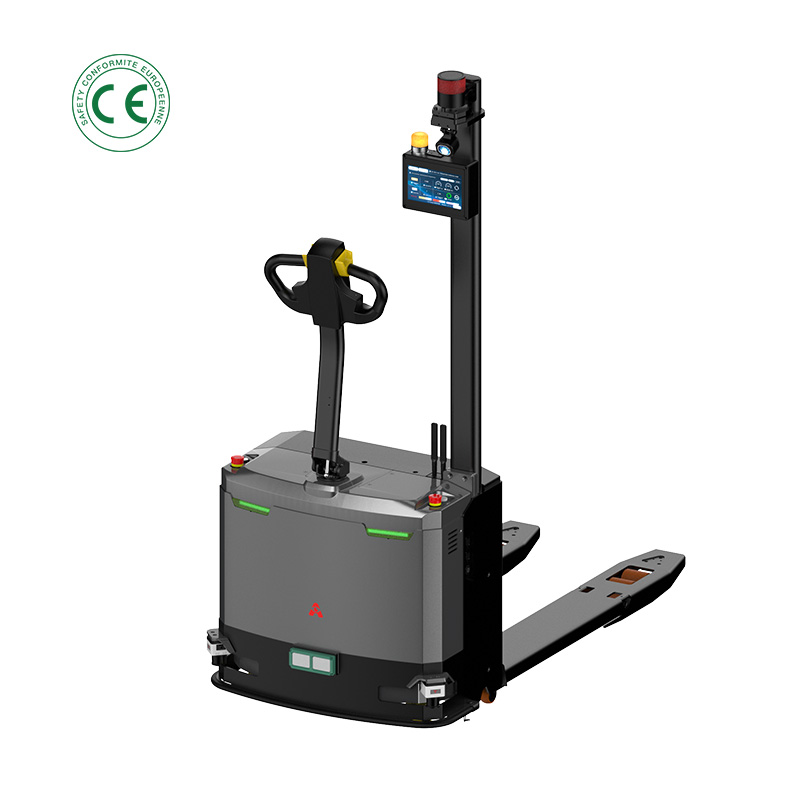
Autonomous Mobile Robot AMR AGV Forklift Pallet Stacker CE Certificate for Smart Warehouse and Production Line Automation
CE-certified laser SLAM AMR forklift with pallet stacker function for smart warehouse and production-line automation. Best when the buyer needs trackless navigation, rapid layout changes and export-ready CE documentation.
View specification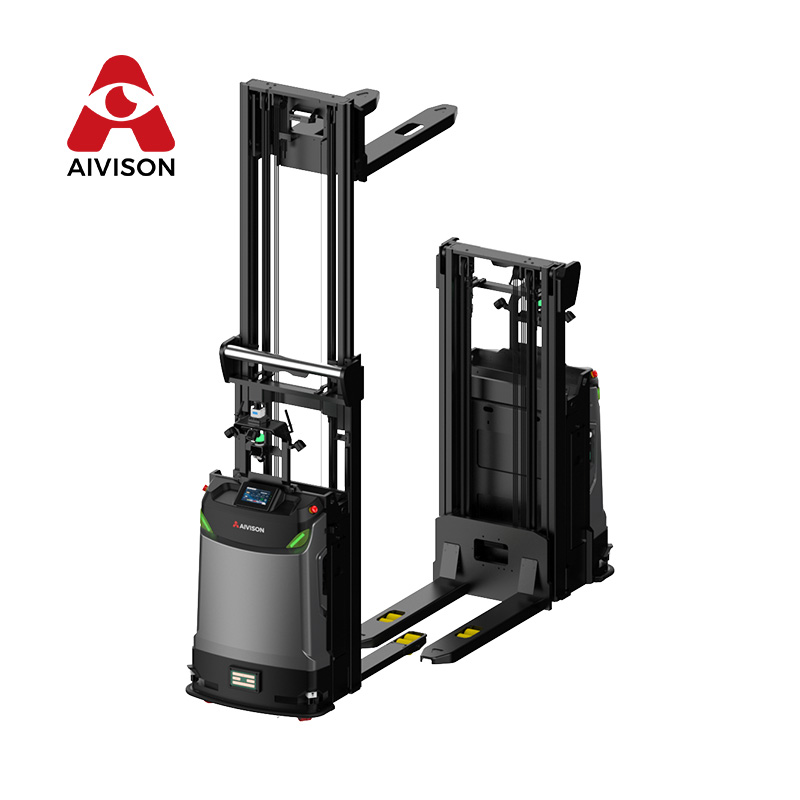
High Precision agv Forklift Full Servo Motor Controlled Laser Forklift with Heavy Load 2000kg
2000 kg heavy-load laser forklift with full servo motor control. A strong fit for high-precision docking, repetitive pallet transfer and replacing manual counterbalance trucks in tight takt-time flows.
View specification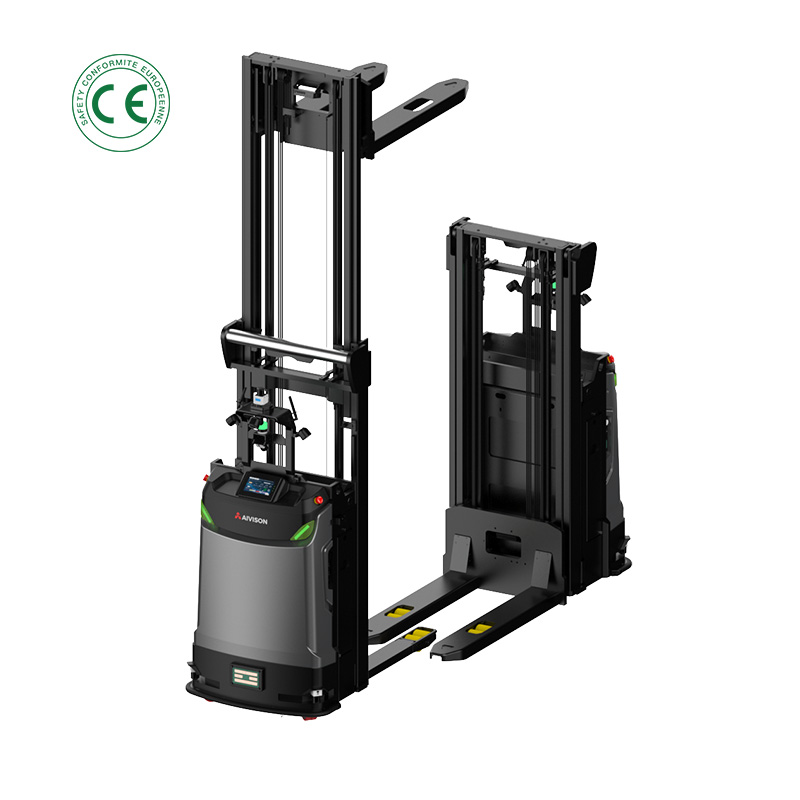
Factory AMR Robot AGV Robot Laser 2000kg Forklift AGV for Industrial Material Handling
2000 kg laser forklift AGV engineered for industrial material handling. Specified when factory floors must remain unchanged and the robot must map natural features instead of following fixed tracks.
View specification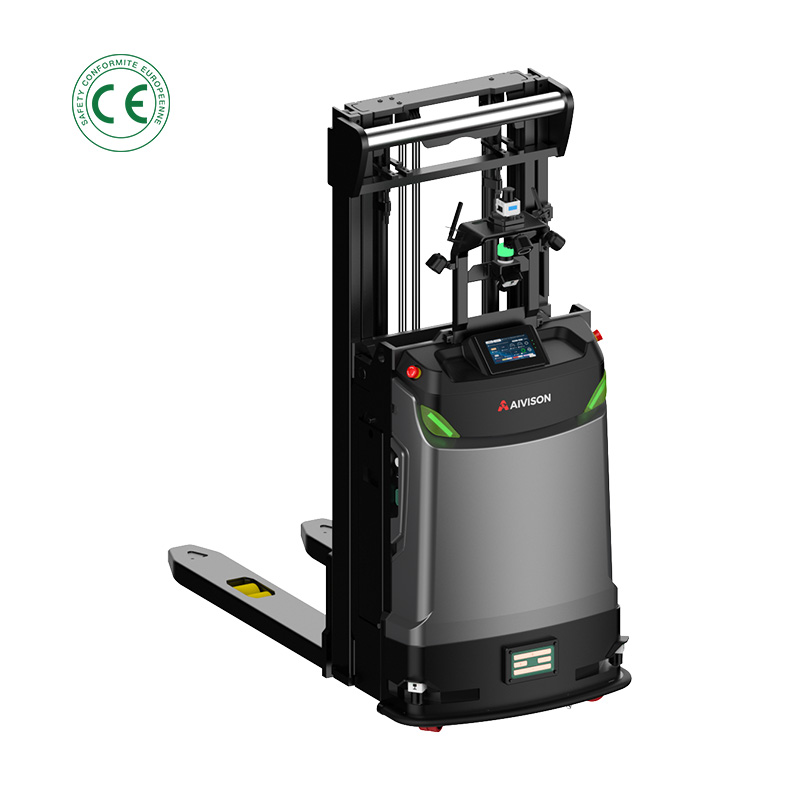
Warehouse Robot Robotics 2000KG CE Warehousing Automatic Forklift Stacking AGV
CE-marked 2000 kg automatic warehouse stacking AGV. A recommended benchmark for high-shelf storage, pallet stacking and 24/7 warehouse duty where uptime and safety interlock proof matter.
View specification
Hot Selling Logistics Navigation Detector Sensor Lidar Manufacturers Direct Sales
LiDAR navigation and obstacle-detection sensor for AGV and AMR projects, available through manufacturer direct sales. Useful for integrators, wholesalers and factories building or localizing a mobile robot fleet.
View specification
Aivison Stacker Truck Pallet Stacker Forklift Agv 1.5 Ton Autonomous Forklift Smart Deliver AMR Robot
1.5 ton autonomous stacker truck and pallet stacker AMR for smart delivery. Ideal for wholesalers and integrators who need a compact autonomous forklift platform with OEM and ODM customization potential.
View specification
Omnidirectional Humanoid Robot Chassis Dual 7-DOF Arms Laser SLAM Autonomous Warehouse AMR Mobile Platform
Omnidirectional humanoid robot chassis with dual 7-DOF arms and laser SLAM. A development platform for advanced warehouse AMR applications, machine tending and composite mobile robot research.
View specification
Laser SLAM Navigation Automated Guided Vehicle Forklift agv 1500kg Load Capacity
1500 kg laser SLAM navigation automated guided vehicle forklift. A practical entry point for production-line material flow, line-side delivery and mixed human and vehicle traffic.
View specificationWhat a Top 10 AGV Partner Should Prove Before You Shortlist
The strongest AGV factories are not the ones with the largest catalogue; they are the ones that can prove navigation fit, fleet uptime, customization depth and third-party verification. These figures are the baseline Marnix uses when discussing material handling projects with end users, wholesalers and system integrators.
Procurement teams should challenge every supplier to map these claims to a specific factory address, test protocol, navigation configuration and service model. A wholesale price without engineering evidence is not a lower total cost; it is deferred deployment risk.
What Separates a Top 10 Material Handling AGV Factory from a Catalogue Wholesaler?
A credible Top 10 shortlist should be built on engineering ownership, not brochure payload numbers. Use these ten checks to compare factories, distributors and integrators on the factors that determine whether an AGV project scales after commissioning.
Factory Ownership & Assembly Depth
Ask for the factory address, assembly lines, QC stations and third-party onsite reports. A wholesaler can resell, but it must expose the manufacturing source and engineering escalation path.
Navigation Fit to the Station
Laser SLAM reaches ±5 mm on natural features; QR-assisted docking reaches ±2 mm only where needed. Over-specifying floor codes adds maintenance and layout-change costs.
Payload, Mast & Rack Engineering
Verify 1500 kg, 2000 kg, 1.5 ton or 300 kg light pallet platforms against rack footprint, lift height, center of gravity and aisle width. Payload must be derated safely.
Fleet Software & Wi-Fi Scheduling
Demand evidence of simultaneous dispatch, traffic control, task allocation, WMS/MES interfaces and battery-aware routing — not only single-robot demonstration videos.
Charging Ecosystem & Uptime
Compatible intelligent charging docks, opportunity charging and spare battery strategy determine 24/7 duty. Ask how fleet size changes when charging windows shrink.
Custom Top Modules
Jacking units, roller conveyors, forklift forks, 6-axis arms and dual 7-DOF humanoid platforms should be engineered around the production interface, not forced into a standard fit.
Quality Protocol & Stress Testing
Multi-stage intelligent inspection and thousands of operational stress tests should precede shipment. Request the pre-shipment acceptance test plan and failure-response workflow.
Integrator & Wholesaler Support
CAD drawings, electrical interfaces, API or IO documentation, commissioning support, spare parts and training are essential for distributors and system integrators reselling AGVs.
Third-Party Credibility
TÜV Rheinland onsite assessment, Fortune 500 supply evidence, credit index, transaction history and country-specific certifications shorten procurement risk review.
TCO, Spares & Deployment Speed
Compare lead time, spare-part availability, remote support SLA, training, energy cost, floor modification and commissioning risk — not just the robot unit price.
Material Handling AGV Procurement Trends for 2025–2027
Buyers are shifting from equipment purchase to capacity procurement. The RFQ is changing from “what is the payload?” to “what uptime, integration evidence and lifecycle support can you prove?” This is where information gain matters: the best suppliers help buyers avoid over-specification and hidden deployment cost.
TCO and Uptime Contracting
Procurement teams now score 24/7 OEE targets, spare-part response and remote support alongside purchase price. The winning bid is the one with the lowest lifecycle risk, not the lowest initial quotation.
Precision Tiering
Buyers specify ±5 mm for transfer, ±2 mm for station docking and ±0.05 mm only for composite precision assembly. Precision tiering avoids unnecessary QR labels, floor marking and maintenance.
Mixed-Fleet Interoperability
Wholesalers and integrators increasingly require one navigation core and one scheduling layer across forklifts, jacking robots, pallet AMRs and charging docks. Mixed fleets must share routes and task logic.
Factory-Direct OEM / ODM
Distributors need low-MOQ customization, multi-category procurement and engineering documentation. Factory-direct support reduces the risk of a wholesaler promising a top module it cannot actually engineer or service.
Energy Orchestration
Auto charging docks, opportunity charging and battery health monitoring are moving into fleet design. Energy-aware scheduling can reduce charger count and avoid peak-demand conflicts with production equipment.
Verified Supply Chains
Third-party onsite assessment, credit index, transaction history and Fortune 500 supply evidence are becoming standard RFQ attachments. Verification is now part of technical scoring.
Weighted AGV Selection Scorecard
Observed weighting pattern in recent material handling AGV and AMR RFQs where uptime and integration risk are treated as commercial factors.
Product Development Trends to Specify Before You Buy
Material handling AGVs are converging with mobile manipulation, fleet software and modular top interfaces. Buyers who understand these trends can future-proof the chassis and software layer instead of buying a single-purpose machine that becomes difficult to integrate.
Trackless SLAM as Default
Laser SLAM on natural features is replacing magnetic tape and reflector grids. The buyer gains layout freedom, faster reconfiguration and lower floor maintenance, provided the site has been correctly mapped.
QR Assist Only at Stations
QR code cameras are being deployed only at high-precision docking points, raising accuracy to ±2 mm without covering the entire route with floor labels. This is especially relevant for high-shelf storage and wafer handling.
Composite Mobile Robots
AMR mobility is merging with 6-axis arms, roller conveyors and machine-tending modules. Composite robots with ±0.05 mm repeatability move automation beyond transport into precision production support.
Omnidirectional & Humanoid Chassis
Omnidirectional bases and dual 7-DOF arm platforms are appearing in advanced warehouse AMR projects. They suit confined spaces, machine tending and R&D programmes where motion flexibility is a competitive advantage.
Standardized Top Modules
Jacking units, roller conveyors, forks and arm interfaces are becoming modular. Specifying a standard mechanical and electrical interface reduces future changeover cost and lets wholesalers stock a smaller platform range.
Fleet-as-a-System Software
Indoor Wi-Fi scheduling, traffic control and automatic charging are becoming the real differentiator. Buyers should test multi-robot dispatch and recovery logic during evaluation, not only single-machine navigation.

Marnix’s Advantages for AGV Wholesalers and System Integrators
Shenzhen Marnix Intelligent Technology Co., Ltd. combines about ten years of AGV engineering experience with a component-to-fleet approach. Instead of forcing a single catalogue machine, Marnix engineers chassis, payload interface, navigation configuration and charging strategy around the production line — and supports the wholesalers and integrators who serve those end users.
Third-Party Verification That Shortens Procurement Risk
Before adding an AGV factory or wholesaler to a shortlist, verify the company premises, trade history, credit record and supply capability. Independent evidence is more useful than a catalogue claim.

TÜV Rheinland Onsite Assessment
Company premises and operations verified by an independent inspection body.

Supplier to Fortune 500
Procurement contract with a Fortune 500 company, assessed by independent third parties.

Verified Multispecialty Supplier
Low-MOQ customization and multi-category robot procurement capability.
Credit & Transaction Records
Transparent credit index and transaction level history for procurement review.
FAQ: Material Handling AGV Factory & Wholesaler Procurement
Straight answers for buyers comparing AGV factories, wholesalers and system integrators. For project-specific evaluation, share your load profile, floor layout, throughput and docking tolerance.
What should I compare when selecting a material handling AGV factory?
Compare navigation fit, payload and mast engineering, fleet scheduling software, charging ecosystem, customization capability, QC protocol, third-party verification and total cost of ownership. A wholesaler may be a valid channel, but it should document the factory source and engineering escalation path.
Do I need to modify my factory floor for laser SLAM AGVs?
No for standard laser SLAM. Marnix robots map existing natural features, so auxiliary tracks, magnetic tape and floor QR codes are not required. QR labels are added only at stations where ±2 mm docking precision is needed.
What is the difference between ±5 mm, ±2 mm and ±0.05 mm?
±5 mm is typical for natural-feature laser SLAM used in warehouse transfer and line-side delivery. Adding a QR code scanning camera raises station docking to ±2 mm. Composite robots with a 6-axis arm can reach ±0.05 mm repeatability for precision production tasks.
Can one supplier cover 1500 kg, 2000 kg and 1.5 ton autonomous forklifts?
Yes, if the supplier has manufacturer-level platform engineering. Marnix offers 1500 kg, 2000 kg and 1.5 ton autonomous forklift configurations, plus 300 kg light AMR pallet robots, jacking robots and composite platforms. The correct model depends on rack footprint, lift height, aisle width and duty cycle.
How many robots and charging docks will my project need?
Fleet size is derived from missions per hour, travel distance, battery window, charging strategy and peak demand. A proper calculation should include opportunity charging, charger count and traffic congestion — not just the average transfer time.
Can AGVs integrate with WMS, MES, conveyors and production equipment?
Yes, when the supplier provides documented IO, API or scheduling interfaces. Marnix customizes top modules such as roller conveyors, jacking units, forks and 6-axis arms so the robot can hand over directly to production equipment.
What should a wholesaler verify before reselling AGVs?
Verify the factory address, product certification, navigation test data, spare-part availability, commissioning support and software update path. For project work, check TÜV Rheinland onsite assessment, Fortune 500 supply evidence, credit index and transaction history.
How do I start a project evaluation with Marnix?
Send your payload, rack or pallet footprint, floor layout, throughput target, aisle width, Wi-Fi coverage and docking precision requirements. The engineering team can then recommend the navigation configuration, robot model, fleet size and charging approach.
Turn Your AGV Shortlist into a Verified Configuration
Share your load profile, floor layout, throughput and docking tolerance. Marnix engineers will map the right combination of laser SLAM forklifts, jacking robots, pallet AMRs, charging docks and top modules — with the precision level matched to each station rather than over-specified across the whole route.
Get Catalog Project evaluation: info@marnixbot.com · Shenzhen Marnix Intelligent Technology Co., Ltd.