What a Pallet Handling Robot Must Prove Before It Enters Your Factory
A pallet handling robot is not simply an AGV with forks attached. It is a production asset that must navigate mixed traffic, dock accurately, hand over loads safely, communicate with line equipment, and remain serviceable for years.

Pallet movement is the hidden cost center of many factories and warehouses. It consumes floor space, creates traffic conflicts, depends on manual forklift availability, and often becomes the bottleneck between receiving, staging, production lines, high-bay storage and dispatch. Buyers searching for a China pallet handling robot manufacturer are usually not shopping for a single machine. They are solving a flow problem that touches safety, throughput, labor flexibility and capital payback.
Shenzhen Marnix Intelligent Technology Co., Ltd. approaches pallet automation from the chassis upward. With about ten years of AGV engineering experience, the company builds laser SLAM autonomous mobile robots, jacking robots, smart forklifts, composite mobile robots and intelligent charging docks for semiconductor, 3C electronics, lithium battery, photovoltaic, automotive parts, PCB, textile and medical device industries. The product logic is practical: use natural-feature SLAM navigation where the layout changes, add QR assistance only where ±2 mm docking is required, and reserve ±0.05 mm repeatability for composite robots with robotic arms.
That tiered approach matters during procurement. Many projects over-specify navigation and under-specify integration. A robot that cannot match the rack, conveyor, machine interface or Wi-Fi coverage is not a good investment, even if its positioning number looks impressive on a brochure. The right factory partner should be able to explain where precision is necessary, where it is wasted cost, and how fleet scheduling, charging and service will support daily operation.
Pallet Handling Robot Procurement Trends Reshaping 2025–2030
Buying behavior is moving from isolated robot purchases toward fleet-level operational infrastructure. The strongest proposals now answer total cost, safety, data visibility and service continuity.
Fleet-Level Procurement Replaces Single-Robot Trials
Procurement teams now ask how many robots, how many charging docks, how traffic is controlled, and how tasks are dispatched across shifts. A single demonstration robot is no longer enough evidence. Buyers want a fleet plan linked to peak throughput, battery strategy and expansion phases.
Precision Tiering Reduces Infrastructure Cost
Instead of covering the entire floor with codes or reflectors, buyers are adopting tiered precision: ±5 mm SLAM for main routes, ±2 mm QR docking only at critical stations, and higher repeatability only for robotic assembly. This lowers installation time and preserves layout flexibility.
Open Integration and Mixed Fleets Become Mandatory
Factories rarely automate every aisle at once. They need pallet AMRs, autonomous forklifts, jacking robots and existing conveyors to coexist. Procurement now favors suppliers who can expose stable interfaces, support integrators, document equipment handshakes and participate in multi-vendor projects.
Total Cost of Ownership Drives Decisions
Purchase price is only one line in the business case. Buyers now compare installation labor, floor modification, energy consumption, charging ratio, spare-parts availability, remote support and uptime commitments. A slightly higher robot price can be the cheaper project when service and reliability are stronger.
Safety and Traceability Move into the Contract
Mixed human and forklift traffic makes safety evidence essential. Procurement teams request risk assessment, obstacle-avoidance behavior, emergency-stop design, operating-zone definitions, event logs and clear maintenance procedures. Traceability is becoming as important as payload capacity.
Modular Top Mechanisms Replace One-Off Machines
Demand is growing for a proven navigation chassis with interchangeable top modules: forks, jacking units, roller conveyors, lifting platforms and robotic arms. Modularity shortens engineering cycles and protects the investment when production processes change.
Where Pallet Handling Robots Are Heading Next
The next competitive gap is not only navigation accuracy. It is how well a robot understands its environment, coordinates with other equipment and improves uptime through software.
Vision + Lidar Fusion
Lidar remains the backbone for mapping, but vision adds pallet recognition, fork-entry guidance and detection of irregular loads. Fusion improves reliability when racks are moved, lighting changes or pallet condition varies.
Semantic and Dynamic Navigation
Robots are moving from geometric maps toward environment-aware routing. They recognize people, forklifts, doors, charging zones and congested areas, then adjust speed and route selection to protect takt time and safety.
Fleet Scheduling and Digital Twins
Wi-Fi fleet scheduling is becoming an operations layer. Digital twins help buyers test aisle widths, charging ratios and robot quantities before deployment, reducing the risk that a fleet is oversized or underpowered.
ROS2, Open Platforms and Mobile Manipulation
Open platforms and ROS2-based development are expanding pallet handling into mobile manipulation. Composite robots with 6-axis arms and dual-arm humanoid chassis allow pickup, placement and machine tending beyond simple transfer.
8 Pallet Handling Robots and Modules from Our Factory
Each platform is linked to its original product page. All eight options use images and URLs from the source range, so buyers can compare payload, navigation, applications and customization potential without losing specification context.

AGV AMR Autonomous Forklift Smart Version Auto Mobile Transfer Stacker Robot
Recommended for high-throughput pallet transfer between receiving, staging and dispatch, especially where manual forklift availability limits shift performance.
View product →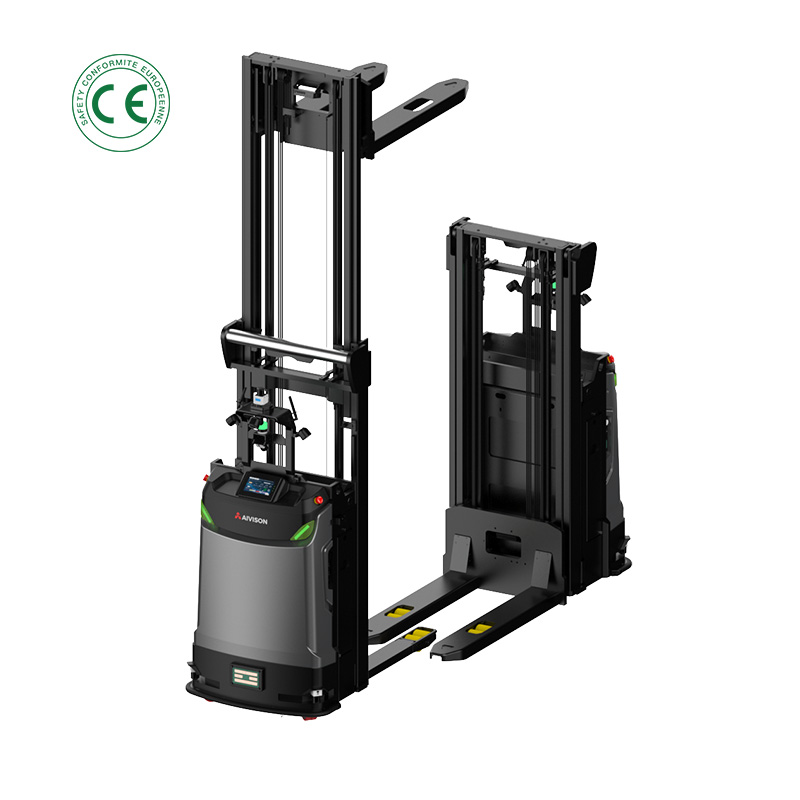
Factory AMR Robot AGV Robot Laser 2000kg Forklift AGV for Industrial Material Handling
Best for 2,000 kg industrial material handling where laser navigation should avoid magnetic tape, reflectors or floor QR codes along the main route.
View product →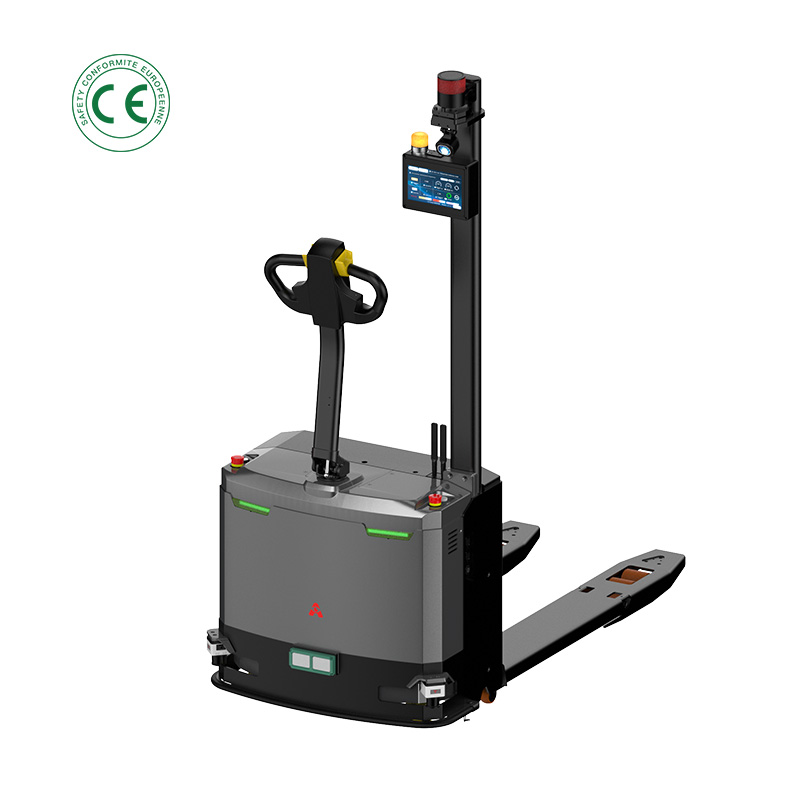
Autonomous Mobile Robot AMR AGV Forklift Pallet Stacker CE Certificate for Smart Warehouse and Production Line Automation
A strong fit for smart warehouses and production-line links that require CE-oriented documentation and reliable pallet stacker performance in mixed traffic.
View product →
Hot Selling Logistics Navigation Detector Sensor Lidar Manufacturers Direct Sales
An important perception module for integrators building pallet robots or retrofitting navigation systems. Direct-source supply can simplify BOM control and testing.
View product →
New Warehouse Autonomous Cars agv Robot 2000kg Load Capacity Stacker agv Robot
Recommended for new warehouse layouts where 2,000 kg stacker tasks must share aisles with people, pallet trucks and manual equipment without dedicated lanes.
View product →
Heavy Load 2000KG Load Forklift Laser Guide AMR for Warehouse Pallet
Suited to heavy-load pallet work in high-bay or buffer storage where ±5 mm SLAM navigation is sufficient and floor modification must be avoided.
View product →
Customizable 1500KG Traction Capacity AGV Autonomous Mobile Robot Amr with Lidar Guided Sensor
Best for 1,500 kg traction and towing applications, including cart trains and mobile pallet flow that need customizable bodies and lidar guidance.
View product →
Humanoid Robot Chassis Dual 7-DOF Arms Laser SLAM Omnidirectional Navigation ROS2 Open Platform AMR
A development platform for advanced automation teams exploring mobile manipulation, dual-arm tasks and ROS2 integration beyond standard pallet handling.
View product →Why Marnix Is Built for Pallet Automation Projects
As a Shenzhen manufacturer with about ten years of AGV engineering experience, Marnix combines product breadth, precision tiering and customization for end users and system integrators.
Complete AMR and Pallet Robot Portfolio
Jacking robots, smart forklifts, pallet AMRs, autonomous stackers, composite robots, humanoid development platforms and compatible charging docks come from one engineering source. This reduces integration friction when a project needs more than one load-handling method.
Precision Without Forced Floor Rework
Laser SLAM reaches ±5 mm without tape, reflectors or floor QR codes on natural features. A QR scanning camera can raise docking accuracy to ±2 mm where needed, and composite robots with a 6-axis arm reach ±0.05 mm repeatability for high-value assembly.
Manufacturer-Level Customization
Customization covers chassis, payload, lifting units, roller conveyors, forklift forks and robotic arms. Instead of forcing a standard robot into a non-standard process, Marnix can engineer the interface around the production line and handover point.
Wi-Fi Fleet Scheduling and Charging
Robots are coordinated by an intelligent scheduling system over indoor Wi-Fi, supporting simultaneous task assignment, traffic control and automatic charging with compatible smart docks. This is essential for 24/7 pallet flow and multi-shift operations.
Quality Testing and Verified Credentials
Multi-stage intelligent inspections and operational stress testing target near-zero failure rates before shipment. The company has undergone onsite supplier assessment by TÜV Rheinland and is a verified supplier to Fortune 500 companies, with 200+ manufacturers served across three continents.
Integrator-Ready Support
System integrators can source standard platforms, custom top modules and lidar components, then combine them with their own controls and project delivery. Product documentation, interface discussions and configuration reviews help shorten the engineering cycle.
How to Specify the Right Pallet Handling Robot
Match the platform to the load, route, docking precision and handover equipment. The table below is a practical starting point for a procurement RFQ.
| Application | Recommended Configuration | Navigation Precision | Procurement Note |
|---|---|---|---|
| Warehouse receiving to storage | Autonomous forklift or pallet AMR with automatic charging | ±5 mm | Confirm pallet quality, aisle width, peak pallets per hour and charging ratio. |
| High-bay storage and precision docking | SLAM plus QR code camera at selected stations | ±2 mm | Use QR only where handover demands it; keep main routes code-free. |
| Production-line line-side delivery | Jacking robot, roller-top AMR or custom top module | ±5 mm | Map takt time, handover height, conveyor signals and operator intervention. |
| Narrow aisle or light material flow | 300 kg light AMR or 1,500 kg traction platform | ±5 mm | Validate floor flatness, turning space, slope and safety clearance. |
| Semiconductor, medical or complex assembly | Composite mobile robot with 6-axis arm | ±0.05 mm | Plan station calibration, cleanroom requirements and safety validation. |
| Integrator or OEM project | Custom chassis with fork, jacking, roller or arm module | Project-specific | Request interface definitions, fleet software support and acceptance criteria. |
What to Prepare Before Requesting a Pallet Robot Quote
From our project experience, these six inputs determine most of the robot selection and shorten evaluation from weeks to days.
Load Profile
Provide maximum weight, pallet footprint, load height, center of gravity and whether the load is stable enough for autonomous fork entry. Include rack or shelf dimensions if the robot must lift them.
Site Layout
Share CAD or a clear sketch with aisle widths, doors, slopes, elevator or lift points, charging locations and no-go zones. Layout changes are easier to plan before robot quantity is fixed.
Throughput Target
State missions per hour, peak periods and shift pattern. This determines fleet size, battery strategy and the number of charging docks more reliably than total warehouse area.
Docking Precision
Identify where ±5 mm SLAM is enough, where ±2 mm QR assistance is required, and where robotic-arm precision is necessary. Precision tiering protects both budget and layout flexibility.
Wi-Fi and Fleet Coverage
Review access points, dead zones and roaming quality across the robot operating area. Stable indoor Wi-Fi supports task dispatch, traffic control and automatic charging coordination.
Equipment Interfaces
List conveyors, machines, safety doors or shelving the robot must hand over to. Mention PLC, API, I/O or ROS2 requirements early so the top module and software scope are accurate.
Pallet Handling Robot Buying Questions
These are the questions buyers ask most often when comparing a pallet AMR, autonomous forklift, jacking robot and custom mobile platform.
What is a pallet handling robot?
A pallet handling robot is a mobile automation platform that moves pallets, racks or pallet-sized loads without a human driver. It may use forks, jacking units, roller conveyors or lifting platforms, and it usually combines laser SLAM navigation, safety sensors and fleet software. It differs from a fixed conveyor because routes can be changed in software.
Should I choose a pallet AMR or an autonomous forklift?
Choose a pallet AMR when loads are low to medium height, aisles are controlled and the main need is horizontal transfer. Choose an autonomous forklift or stacker when the robot must lift pallets onto racks, feed production lines or handle heavier loads. Many sites use both in one fleet.
Do pallet handling robots require floor modification?
Not with natural-feature laser SLAM. The robot maps existing walls, pillars and fixed equipment, so no magnetic tape, reflectors or floor QR codes are required on main routes. QR labels are only added at stations where ±2 mm docking precision is needed.
What payload should I specify?
Specify the maximum loaded weight plus a safety margin, then confirm the load center of gravity and fork or jacking interface. For example, a 2,000 kg stacker may be appropriate for heavy pallets, while a 300 kg light AMR can be more efficient for small carriers and narrow aisles.
How many robots and charging docks do I need?
Start with missions per hour, travel distance, lift or docking time, peak demand and acceptable response time. Then model charging windows and battery capacity. A fleet study is more accurate than dividing total pallets by one robot cycle, because traffic and handover wait time affect real throughput.
Can one fleet mix forklifts, jacking robots and custom modules?
Yes, when the robots share a navigation core and fleet scheduling layer. Marnix platforms can be configured with jacking units, forks, roller conveyors or robotic arms, then coordinated over indoor Wi-Fi for task assignment, traffic control and automatic charging.
Turn Pallet Movement into Measurable Uptime
Share your load profile, layout, throughput target and docking precision with our engineering team. We will recommend a pallet handling robot configuration, fleet size and charging strategy based on the actual flow, not a generic catalog number.
Shenzhen Marnix Intelligent Technology Co., Ltd. · info@marnixbot.com · Laser SLAM AMR, jacking robot and smart forklift manufacturer