8 Mobile Logistics Robot Platforms for Pallet, Rack, Forklift and Line-Side Handling
These platforms cover the practical buying intents behind “China top mobile logistics robot manufacturer & suppliers”: pallet transfer, rack lifting, autonomous forklift work, conveyor-line handover, heavy-load pallet handling and AI-ready mobile manipulation. Product URLs are preserved from the original catalogue; the notes below add application context that a standard listing usually leaves out.
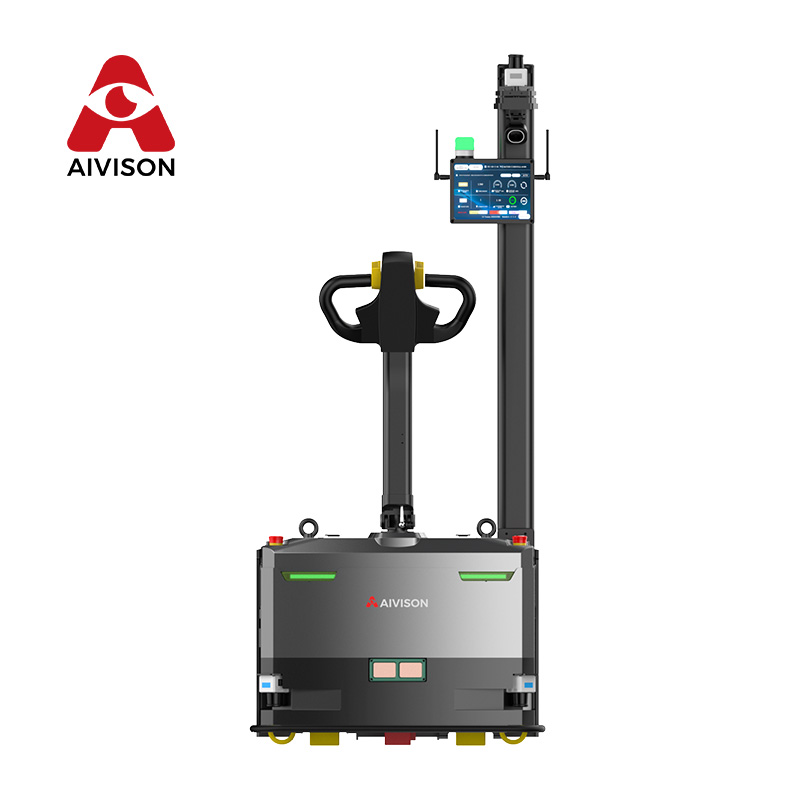
China Factory Movable Pallet Agv Robot Rack Shelf for Intelligent Robot Warehouse
A factory-built movable pallet AGV rack platform for intelligent warehouses. Use it when the rack, shelf or pallet remains the transport unit and the process needs repeatable pick-up and drop-off without floor magnets. Best fit: buffer storage, line-side rack movement and mixed manual-automatic warehouse zones.
View product details →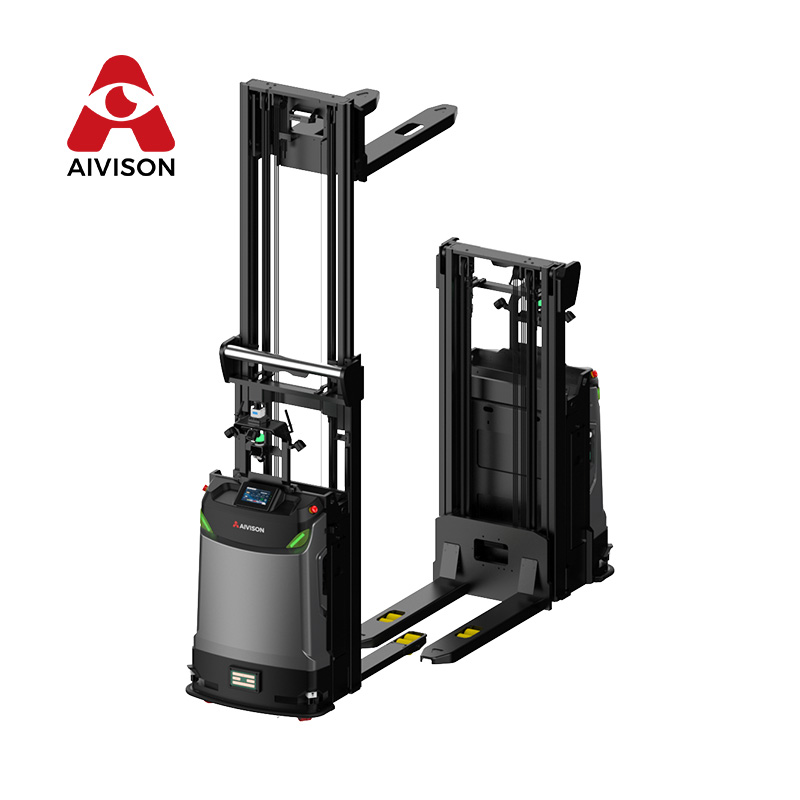
High Precision agv Forklift Full Servo Motor Controlled Laser Forklift with Heavy Load 2000kg
Full-servo motor control and laser navigation support heavy pallet handling up to 2,000 kg. This is the platform to evaluate when pallet quality, fork entry and smooth acceleration affect both cycle time and load stability. Ask for a cycle-time simulation if aisle traffic is dense.
View product details →
AGV AMR Autonomous Forklift Smart Version Auto Mobile Transfer Stacker Robot
Smart-version autonomous forklift and stacker for automatic transfer, put-away and replenishment. It is typically shortlisted for warehouses that want forklift work automated but do not need a custom top module. Confirm pallet heights, rack clearances and Wi-Fi coverage before sizing the fleet.
View product details →
Warehouse Stacker CE Forklift AGV 800kg Load Capacity Light AMR Pallet
A CE-oriented warehouse stacker concept with 800 kg load capacity for lighter pallets and compact aisles. Good for secondary logistics, packaging lines and dispatch buffers where a 2,000 kg forklift is oversized or physically too large. Match fork length and lift height to the actual rack profile.
View product details →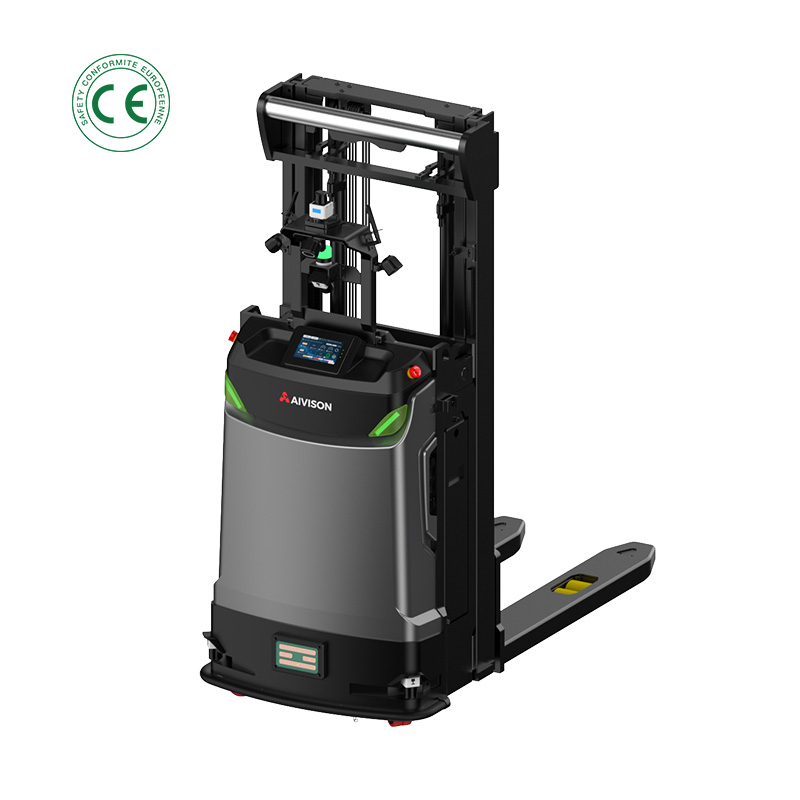
Aivison AMR Robot Whicle Automated Warehouse Automatico agv Logistics Industrial Guided Vehicles
Aivison industrial AMR vehicle for automated warehouse logistics. A practical starting point for repetitive horizontal moves where the buyer wants laser-guided navigation without a full conveyor rebuild. Pair it with fleet scheduling and compatible charging docks for continuous duty.
View product details →
Heavy Load 2000KG Load Forklift Laser Guide AMR for Warehouse Pallet
Heavy-load 2,000 kg laser-guided AMR forklift for pallets in high-bay or production warehouses. The value is not only payload but stable navigation at the rack face. Validate floor flatness, rack tolerance and pallet condition during the site survey before final fleet sizing.
View product details →
AI-Ready Humanoid Robot Chassis Dual 7-DOF Arms Omnidirectional Drive ROS2 Laser SLAM Open Development Platform
Dual 7-DOF arms, omnidirectional drive, ROS2, laser SLAM and an open development platform for AI and robotics teams. This is an engineering platform rather than a standard pallet mover; it suits research groups and integrators building new mobile manipulation use cases.
View product details →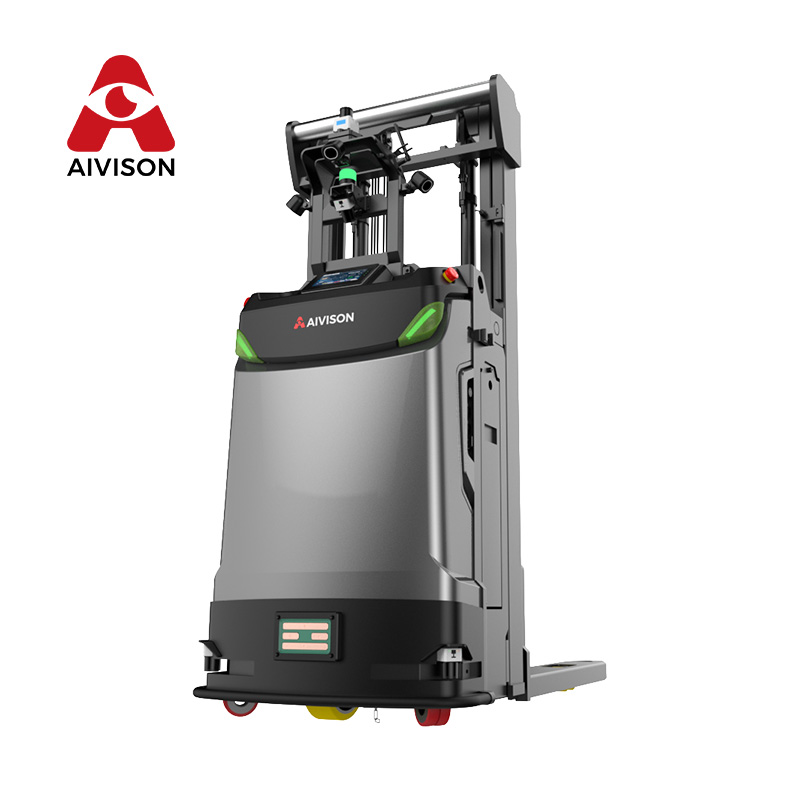
Autonomous Mobile Robots (AMR) Implement Cargo Transportation Between Warehouse and Conveyor Line
Autonomous mobile robots for cargo transportation between warehouse and conveyor line. Select this when the handover point, not the horizontal drive, is the bottleneck. Roller or other top modules can be engineered for direct equipment interfacing with production lines.
View product details →How to Evaluate a China Mobile Logistics Robot Manufacturer, Not Just a Catalogue
Buyers searching for China top mobile logistics robot manufacturer & suppliers usually have two jobs: find a reliable factory and reduce integration risk. A catalogue can show payload and speed, but it cannot prove whether an AMR will hold takt time when aisles are narrow, Wi-Fi is uneven, pallet quality varies or operators cross the route.
Semantic search intent for this topic is commercial-investigation, not casual browsing. Prospective buyers compare laser SLAM versus QR navigation, jacking robot versus autonomous forklift, Chinese direct manufacturer versus trading supplier, and OEM customization versus standard machine. The content below is structured to answer those decisions with information gain: configurable precision, fleet deployment logic, procurement trends, development trends and the evidence a purchasing committee should request.
Marnix’s project approach starts with the interface between the robot and the real process: rack geometry, station docking tolerance, traffic rules, charging strategy, safety escalation and human handover. That is why a mobile logistics robot shortlist should be built around application evidence, not only a supplier’s headline product count.
Application fit before brand claims
Define the load, aisle, floor, handover and safety case first. A robot that looks impressive in a video may still fail at a 4 mm rack tolerance or a congested charging area.
Factory evidence and customization
Ask how the chassis, top module and software can be changed for your line. A direct manufacturer should explain engineering limits, not only promise a standard machine with a new label.
Lifecycle support and integration
Fleet scheduling, Wi-Fi, charging docks, spare parts and integrator documentation matter as much as the robot unit. Validate the service model before the purchase order.
Mobile Logistics Robot Procurement Trends Reshaping 2025–2030 Decisions
Purchasing committees are moving from “Can a robot move this pallet?” to “Can this robot fleet lower total cost of ownership across a live site?” These six trends are appearing repeatedly in serious RFQs.
Total cost of ownership replaces purchase price
Battery strategy, charging ratio, spare parts, service response, route changes and uptime guarantees now count alongside the unit price. A lower-cost robot with unstable docking can be more expensive over three years than a better-integrated fleet.
Brownfield deployment becomes non-negotiable
Most factories cannot stop production for floor magnets or long civil works. Laser SLAM maps the existing environment, so procurement teams increasingly require trackless navigation and minimal infrastructure change.
Mixed fleets need one scheduling layer
Buyers expect jacking robots, pallet AMRs and smart forklifts to share traffic rules, task assignment and charging logic. A manufacturer with a common navigation core and fleet controller reduces integration risk.
Precision is tiered by station, not over-specified
±5 mm natural-feature navigation is enough for travel and general transfer. ±2 mm QR-assisted docking is reserved for high-shelf or precise handover points. This tiered approach avoids unnecessary floor labels and cost.
Integrator-ready customization is expected
System integrators need documented interfaces, configurable top modules and reasonable customization MOQs. They compare suppliers on how quickly a chassis can become part of a complete automation project.
Safety and data evidence enter the RFQ
Risk assessment, person detection, emergency stop, traffic control, event logs and data export are now procurement questions. Buyers want proof that robots can operate around people, forklifts and changing layouts.
Where Mobile Logistics Robots Are Heading: From Trackless Navigation to Composite Robotics
The strongest product roadmap is not simply “faster” or “bigger”. It is a closer match between navigation precision, modular top mechanisms, fleet software and the physical handover point.
Laser SLAM becomes the default navigation layer
Natural-feature laser SLAM delivers ±5 mm positioning without magnetic tape, reflectors or floor QR codes. It supports layout changes and brownfield deployment while keeping the robot independent of fixed infrastructure.
QR-assisted precision appears only where needed
A QR code scanning camera raises docking accuracy to ±2 mm for high-shelf storage, precise line-side stations and other handover points. The trend is selective precision, not covering the entire floor with codes.
Composite robots combine mobility with manipulation
Autonomous mobility combined with 6-axis arms and roller systems creates a composite robot for semiconductor and medical-device production. Multi-layer synchronization protocols can reach ±0.05 mm repeatability.
Top modules become the customization point
Jacking units, roller conveyors, forklift forks and robotic arms allow one chassis platform to serve multiple processes. Buyers increasingly ask for the module to match an existing machine, conveyor or rack interface.
Fleet scheduling moves over indoor Wi-Fi
An intelligent scheduling system over indoor Wi-Fi coordinates simultaneous task assignment, traffic control and automatic charging. The robot becomes part of a managed material-flow network rather than a stand-alone vehicle.
Digital commissioning and data feedback improve
Project teams increasingly request simulation, route validation and event data before site acceptance. This trend supports faster launches and helps operators tune traffic rules as production volumes change.
| Configuration | Accuracy | Floor setup | Best fit |
|---|---|---|---|
| Laser SLAM on natural features | ±5 mm | None — no tape, reflectors or floor codes | Warehouse transfer, line-side delivery, frequent layout changes |
| SLAM plus QR code camera | ±2 mm | QR labels only at precision stations | High-shelf storage, precision docking, wafer handling |
| Composite robot with 6-axis arm | ±0.05 mm | Station calibration | Semiconductor and medical-device assembly |
Marnix Enterprise Advantages: Shenzhen Manufacturing, SLAM Engineering and Verified Trade Record
For high-consideration purchases, E-E-A-T is not a badge on a page. It is the combination of direct manufacturing experience, technical transparency, independent assessment and a project record that buyers can verify.

A Shenzhen mobile robot manufacturer engineering around real production lines
Shenzhen Marnix Intelligent Technology Co., Ltd. draws on about ten years of AGV manufacturing experience to build autonomous mobile robots that drop into existing factories with minimal disruption — for end users and for the system integrators who serve them. The portfolio includes laser SLAM autonomous mobile robots, jacking robots, smart forklifts, composite mobile robots and compatible intelligent charging docks.
Marnix serves semiconductor, 3C electronics, lithium battery, photovoltaic, automotive parts, PCB, textile and medical-device industries. The company is positioned as a manufacturer able to customize chassis, payload and top mechanisms around the production line rather than forcing a standard fit. This is meaningful for buyers comparing China mobile logistics robot suppliers because engineering depth often matters more than a long catalogue.
Credibility signals include an onsite supplier assessment by TÜV Rheinland, status as a supplier to a Fortune 500 company, more than 200 manufacturers served across three continents, verified supplier and trade records, and low-MOQ customization capability. Purchasing teams can review the assessment report, trade history, credit index and transaction level before shortlisting.
About ten years of AGV engineering
Engineering experience matters in the details: drive architecture, sensor placement, service access, safety logic and how a robot behaves when the site is imperfect.
±5 mm SLAM, ±2 mm QR, ±0.05 mm arm
Marnix supports a precision ladder: trackless SLAM for travel, QR-assisted docking for ±2 mm stations and composite robots with 6-axis arms for ±0.05 mm repeatability.
One chassis, many top modules
Jacking units, roller conveyors, forklift forks and 6-axis arms allow a common mobile platform to match different process interfaces and customization requests.
Fleet scheduling over indoor Wi-Fi
The intelligent scheduling system coordinates simultaneous task assignment, traffic control and automatic charging through compatible smart charging docks.
OEM and integrator support
As a manufacturer, Marnix can customize chassis and top modules to connect directly with production equipment, supporting system integrators and end users.
Independently assessed supplier
TÜV Rheinland onsite assessment and Fortune 500 supplier status give procurement teams more to verify than a self-written capability statement.

Where These Mobile Logistics Robots Deliver the Most Value
Proven in complex, mixed-traffic environments where people, forklifts, conveyors and robots share the same floor. The buying decision should be based on the workflow constraint, not the robot category alone.
Warehouse and high-shelf logistics
Dynamic obstacle avoidance adapts to mixed human and vehicle traffic. Millimeter-level precision supports high-shelf positioning, while low failure rate and automatic charging support 24/7 operation.
- Pallet transfer and put-away
- High-shelf docking with QR option
- Continuous scheduled runs
Production-line material flow
Line-side delivery keeps takt time stable across shifts. Coordinated fleets are scheduled over indoor Wi-Fi, optional QR assist enables ±2 mm handover and routes can be re-mapped without floor rework.
- Rack and pallet delivery
- Conveyor and machine handover
- Mixed human-robot zones
Semiconductor, 3C and medical devices
Composite mobile robots add 6-axis arms and roller systems to autonomous mobility. Multi-layer synchronization protocols deliver ±0.05 mm repeatability for precision assembly and transfer tasks.
- Wafer and component handling
- Cleanroom logistics options
- Precision station docking
Lithium battery, PV, automotive, PCB and textile
Jacking robots and smart forklifts fit line-side logistics, heavy pallet handling and warehouse transfer. The right model depends on load profile, rack geometry, aisle width and docking tolerance.
- 2,000 kg pallet handling
- 800 kg and 300 kg light transfer
- Rack lifting and stacker work
What to Prepare Before Requesting a Mobile Robot Proposal
From project experience, these six inputs determine most of robot selection. Sharing them upfront shortens evaluation from weeks of back-and-forth to a focused engineering review.
Load profile
Maximum weight, footprint and center of gravity of racks, pallets or carriers. Include load stability and whether the transport unit is the rack itself.
Site layout
A CAD drawing or sketch with aisle widths, doors, slopes, elevator or lift points, charging space and high-traffic intersections.
Throughput target
Missions per hour and peak periods. This sets fleet size, charging dock count and whether a single robot or coordinated fleet is justified.
Docking precision
Where ±5 mm is enough and where ±2 mm QR assist or arm-level precision is required. Precision should be applied by station, not across the entire floor.
Wi-Fi coverage
Existing access points and coverage quality across the robot operating area. Fleet scheduling, task dispatch and data reporting depend on stable indoor Wi-Fi.
Equipment interfaces
Conveyors, machines or shelving the robot must hand over to, plus any top-module needs such as rollers, forks, jacking units or 6-axis arms.
Mobile Logistics Robot Procurement FAQ
Straight answers for engineering, operations and purchasing teams comparing China mobile logistics robot suppliers.
What navigation accuracy do Marnix AMRs achieve?
Using laser SLAM on natural features, Marnix AMRs reach ±5 mm positioning without magnetic tape, reflectors or floor QR codes. Adding a QR code scanning camera raises accuracy to ±2 mm, and composite robots with a 6-axis arm reach ±0.05 mm repeatability.
Do we need to modify the factory floor?
No for standard laser SLAM deployment. The robot maps the existing environment, so no auxiliary tracks or floor codes are required. QR labels are only added at stations that need ±2 mm docking precision.
Can robots be customized for our production line?
Yes. As a manufacturer, Marnix customizes chassis and top modules such as jacking units, roller conveyors, forklift forks and 6-axis robotic arms to connect directly with production equipment. This supports both end users and system integrators.
How are multiple robots coordinated?
Robots are managed by an intelligent scheduling system over indoor Wi-Fi, enabling simultaneous task assignment, traffic control and automatic charging with compatible smart charging docks.
Which industries and payloads are supported?
Typical industries include semiconductors, 3C electronics, lithium batteries, photovoltaics, automotive parts, PCB, textiles and medical devices. Product examples include 300 kg light pallet AMRs, 800 kg stackers and 2,000 kg laser-guided forklift AMRs, with customization for specific loads.
How do we start a project evaluation?
Share your load profile, floor layout, throughput target, docking precision and equipment-interface needs. Use the inquiry button below or email info@marnixbot.com so the engineering team can recommend the right robot configuration.
Request a Robot Selection Review from Marnix Engineering
Share your layout, load and docking requirement. Our team will recommend a practical mix of jacking robots, pallet AMRs, smart forklifts, composite robots and charging docks for your site — with precision matched to each station instead of unnecessary floor infrastructure.