China Top Autonomous Guided Cart Manufacturers & Exporter
Procurement-grade laser SLAM AGCs, 800–2,000 kg smart forklifts, jacking robots, composite mobile platforms and AI-ready humanoid bases engineered in Shenzhen for global factories, warehouses and system integrators.
Eight Autonomous Guided Cart and AMR Platforms Ready for Evaluation
The fastest way to shortlist a China AGC manufacturer and exporter is to compare real platforms against load, aisle, docking and throughput data. This shortlist covers 2,000 kg laser forklift AGVs, 800 kg warehouse stackers, general laser SLAM AMRs, CE-certified pallet robots and an AI-ready humanoid development chassis. Product URLs are preserved from the manufacturer’s catalog so engineering teams can verify specifications directly.
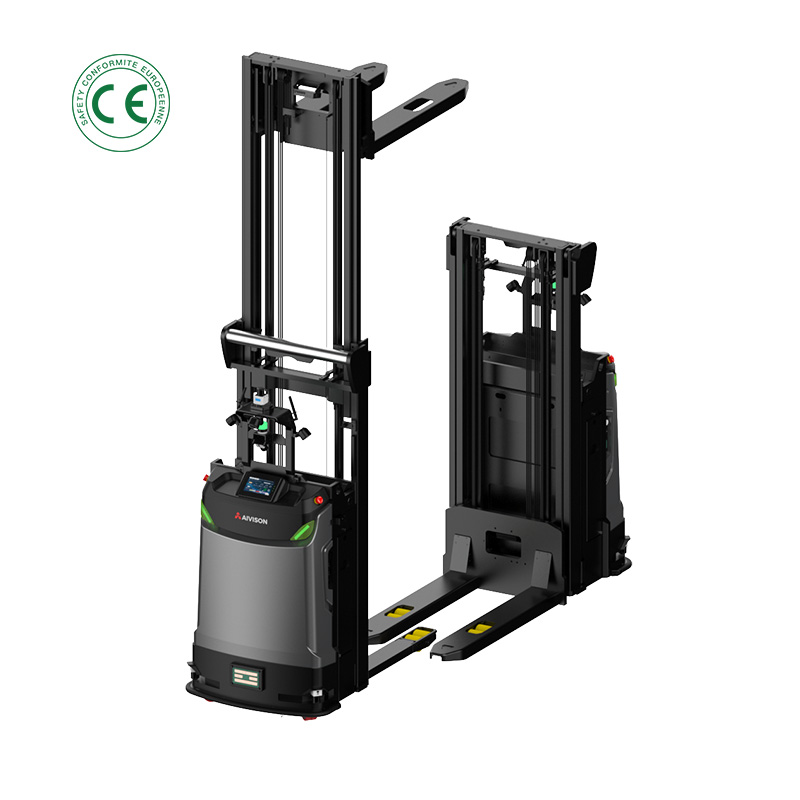
Factory AMR Robot AGV Robot Laser 2000kg Forklift AGV for Industrial Material Handling
A 2,000 kg laser forklift AGV for pallet transfer, heavy WIP movement and industrial material handling. Validate fork dimensions, lift height, aisle profile and safety-scanner fields before quotation.
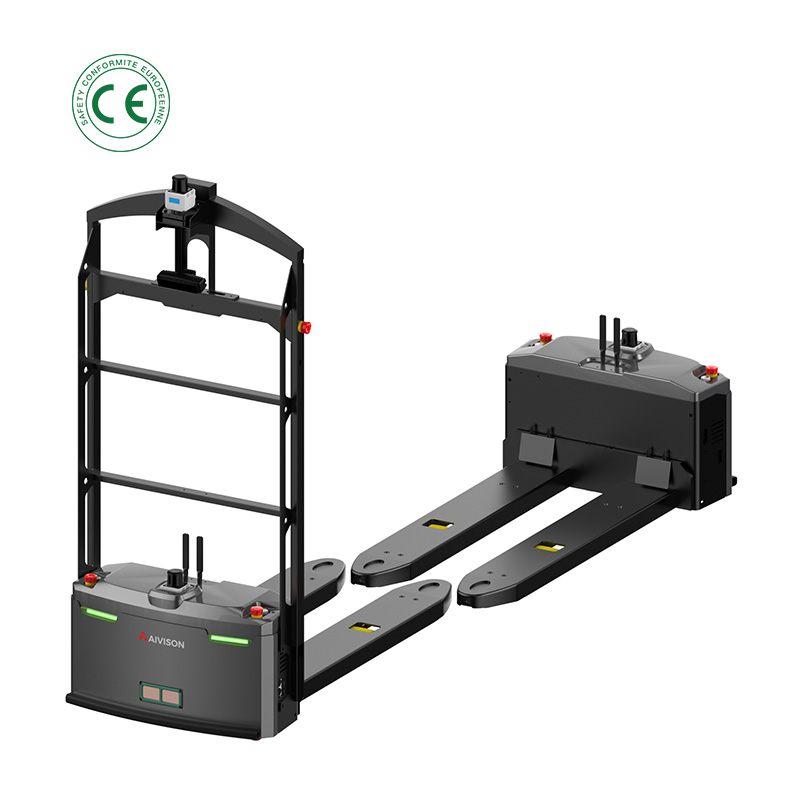
Aivison Customized 800kg Warehouse AGV Robot Lithium Battery AMR
An 800 kg warehouse AGV with lithium battery and customizable AMR architecture for flexible internal logistics, line-side replenishment and transfer tasks where floor infrastructure must stay minimal.
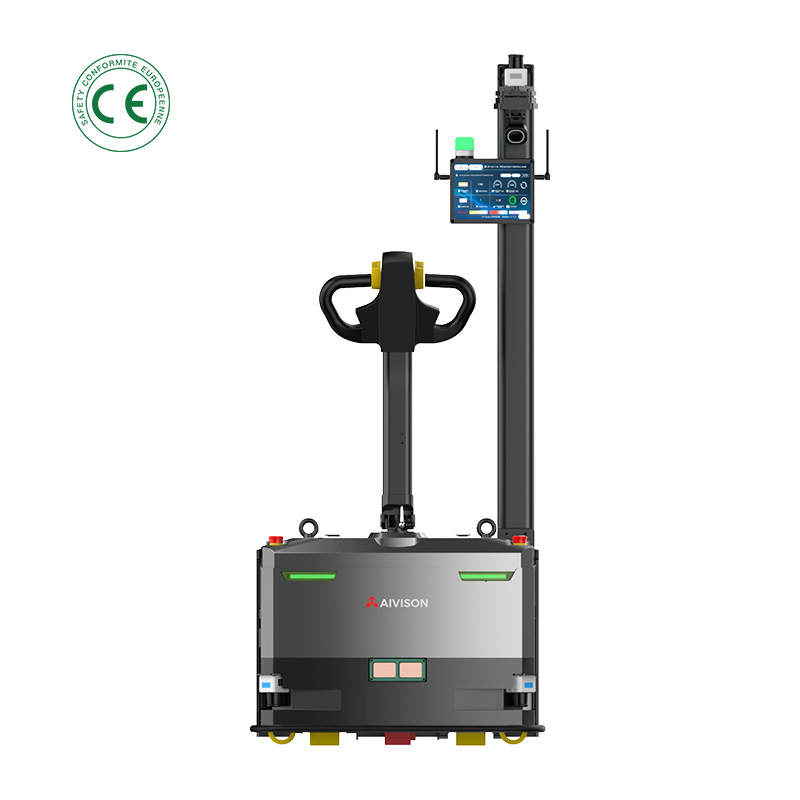
Autonomous Mobile Robot AGV CE Laser SLAM Navigation for Material Handling and Logistics
A CE laser SLAM autonomous mobile robot for material handling and logistics. Natural-feature navigation reduces site preparation and supports route changes as warehouse or production layouts evolve.

Warehouse Stacker CE Forklift AGV 800kg Load Capacity Light AMR Pallet
An 800 kg CE forklift AGV stacker for light pallet handling and warehouse stacking. A practical fit for narrower aisles and mixed traffic where full-size forklifts are inefficient or difficult to schedule.
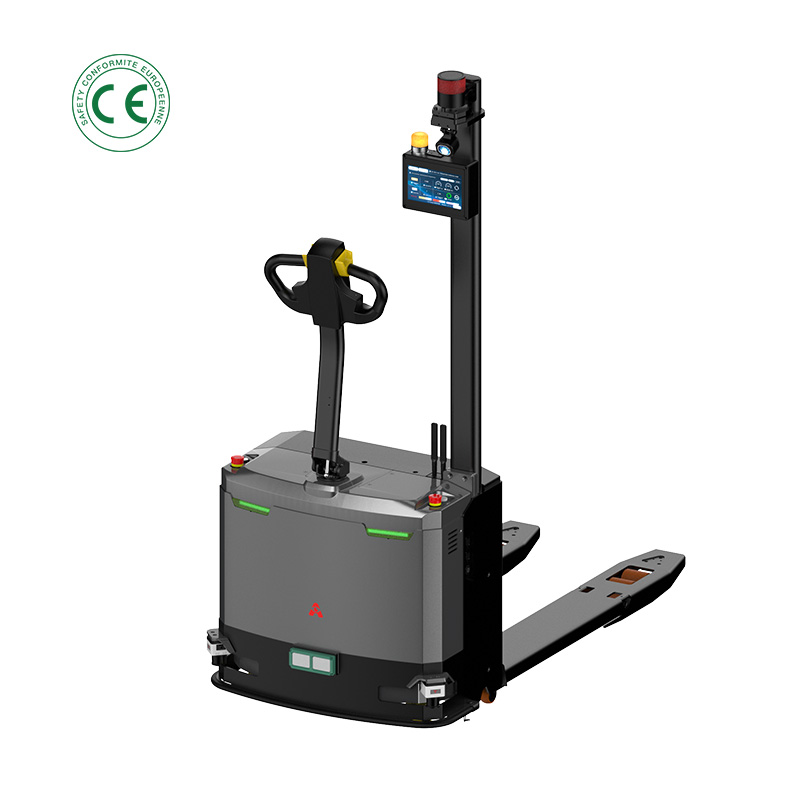
Autonomous Mobile Robot AMR AGV Forklift Pallet Stacker CE Certificate for Smart Warehouse and Production Line Automation
A CE-certified AMR forklift pallet stacker for smart warehouse and production-line automation, combining autonomous navigation with pallet pickup, transfer and handover at designated stations.

Heavy Load 2000KG Load Forklift Laser Guide AMR for Warehouse Pallet
A heavy-load 2,000 kg laser-guided forklift AMR for warehouse pallet flow. Review floor flatness, ramp limits, pallet tolerance, traffic rules and charging strategy before final fleet sizing.

Automatic Handling CE Certificate 2000kg Forklift Robot Vehicle Laser AGV for Large Load Goods-carrying
A CE-certified 2,000 kg automatic forklift robot vehicle for large-load goods carrying. Ask for risk assessment, safety laser configuration, FAT/SAT criteria and site acceptance responsibilities.

AI-Ready Humanoid Robot Chassis Dual 7-DOF Arms Omnidirectional Drive ROS2 Laser SLAM Open Development Platform
An AI-ready humanoid robot chassis with dual 7-DOF arms, omnidirectional drive, ROS2 and laser SLAM. An open development platform for research teams and advanced mobile manipulation pilots.
Why AGC Procurement Is Becoming a Factory-Wide Decision
Buyer intent is shifting from “find a low-cost AGV” to “qualify a mobile robotics partner who can prove navigation accuracy, safety logic, integration capability and lifecycle support.” The most competitive China AGC exporters therefore answer technical questions before price questions.
Search Intent Has Moved Upstream
High-intent buyers now compare laser SLAM AMR, smart forklift, jacking robot and autonomous guided cart terminology in the same evaluation. The winning content must connect product specifications to real decisions: aisle width, payload center of gravity, docking repeatability, Wi-Fi coverage, charging ratio and acceptance testing. It must also explain when a simpler platform is the better engineering choice.
China’s Advantage Is Engineering Iteration
The strongest Chinese mobile robotics suppliers are no longer competing only on component cost. They combine LiDAR, cameras, lithium batteries, drive units, fleet software and customization inside a dense supplier ecosystem. That shortens prototype-to-pilot cycles, supports OEM and ODM requests, and lets manufacturers such as Shenzhen Marnix Intelligent Technology Co., Ltd. tune chassis and top modules around a production line rather than force a standard fit.
The Buying Center Has Widened
Operations wants throughput. EHS wants risk assessment and human-detection logic. IT/OT wants APIs, map governance and cybersecurity. Finance wants total cost of ownership. Procurement wants verified supplier evidence. A credible AGC/AMR proposal therefore needs navigation data, safety documents, fleet architecture, service-level assumptions and commercial clarity in one package. This is where manufacturer transparency becomes a competitive advantage.
Why Shenzhen Marnix Reduces Autonomous Guided Cart Project Risk
Shenzhen Marnix Intelligent Technology Co., Ltd. is a manufacturer, not a catalog reseller. Its advantage is the combination of a common SLAM navigation core, customizable top modules, fleet software, charging infrastructure and export documentation—supported by an installed base across eight core industries.
Shenzhen Engineering Base With About Ten Years of AGV Experience
Located in Shenzhen, Guangdong, the company combines mechanical design, navigation software, fleet scheduling and applications engineering. That proximity to electronics, LiDAR, battery and motion-component suppliers helps shorten customization and response cycles for global buyers.
Complete AMR Portfolio From One Source
Jacking robots, laser SLAM AMRs, smart forklifts, pallet robots, composite mobile robots and compatible intelligent charging docks share a navigation and fleet-control foundation. Mixed fleets can be evaluated with fewer integration unknowns.
Precision Without Unnecessary Floor Rework
Laser SLAM reaches ±5 mm on natural features without tape, reflectors or floor QR codes. Add a QR scanning camera only where ±2 mm docking is required, and use composite robots with a 6-axis arm where ±0.05 mm repeatability is needed.
Manufacturer-Level Customization for Integrators
Chassis, payload, jacking units, roller conveyors, forklift forks and 6-axis arms can be engineered around production equipment. Integrators can request OEM/ODM support instead of adapting a fixed catalog model to an incompatible process.
Wi-Fi Fleet Coordination and Automatic Charging
An intelligent scheduling system coordinates simultaneous task assignment, traffic control and charging over indoor Wi-Fi. Compatible smart charging docks support continuous duty cycles, but correct AP coverage, handover rules and dock count still need to be designed for your site.
Verified Export Credentials and Quality Culture
The company reports more than 200 manufacturers served across three continents, a procurement contract with a Fortune 500 company, and an onsite supplier assessment by TÜV Rheinland. Multi-stage intelligent inspections and operational stress tests target near-zero failure rates before shipment.
Product Recommendations by Application and Search Intent
Use these starting points to structure a shortlist, then validate with a site survey, safety review and factory acceptance test. For buyers searching “China AGC manufacturer,” “2000kg laser forklift AGV exporter” or “custom AMR for production line,” the fastest path is to match the platform to the material flow rather than to a generic product category.
2,000 kg Pallet and Heavy WIP Flow
Prioritize a 2,000 kg laser forklift AGV or heavy-load forklift AMR when pallet weight, fork entry tolerance and lift height dominate the project. Request floor flatness data, pallet condition photos and traffic rules for mixed forklift zones.
See heavy-load platform800 kg Warehouse Stacking in Tighter Aisles
Use an 800 kg CE forklift AGV stacker when the load is lighter but aisle space and maneuverability matter. Validate rack beam height, pallet overhang and QR or SLAM docking strategy at each stacker station.
See 800 kg stackerFlexible Line-Side Logistics and Layout Changes
Choose a general laser SLAM AMR when routes change often and floor infrastructure must stay minimal. Ask for map version control, dynamic obstacle handling, lift/elevator coordination and fleet scheduling evidence.
See laser SLAM AMRAI, ROS2 and Mobile Manipulation Development
Select an AI-ready humanoid chassis or open development platform for research and advanced pilot projects. Define SDK access, payload, duty cycle, safety envelope and support model before comparing hardware price.
See open platformProcurement Trends Reshaping China AGC and AMR Sourcing, 2025–2030
Automation buyers are becoming more sophisticated. The winning RFQ is no longer a payload and price table; it is a lifecycle document that links navigation performance, safety evidence, integration interfaces and service assumptions to production outcomes.
Total Cost of Ownership Replaces Sticker Price
Procurement teams increasingly compare energy consumption, battery cycle life, spare-parts availability, charger count, uptime and remote-support response rather than only unit price. A lower-cost AGC with poor map recovery or weak spare-parts planning can cost more over a five-year horizon than a better-integrated platform.
Standards Evidence Enters the Shortlist
For driverless industrial trucks, buyers reference ISO 3691-4 and, for U.S. projects, ANSI/ITSDF B56.5 as part of risk assessment discussions. CE documentation, emergency-stop logic, safety laser fields, warning zones and human-detection validation should be requested before commercial comparison.
Fleet Interoperability and Open APIs
Factories rarely want a single-vendor island. RFQs increasingly ask for VDA 5050 compatibility or equivalent APIs for master control, task dispatch and status reporting. Map ownership, version control and data export rights should be defined in the contract, not discovered during commissioning.
Modular Payload Procurement
Instead of buying one fixed robot type, integrators prefer a proven SLAM chassis plus interchangeable top modules: jacking units, roller conveyors, forklift forks and robotic arms. This approach simplifies spare parts, training and future line changes while preserving a common fleet interface.
Energy Strategy and Charging Ratio
Battery capacity alone is not an energy strategy. Buyers now model opportunity charging, charger-to-robot ratio, peak shift demand and battery degradation. A well-designed automatic charging layout can reduce fleet size, but it must be validated against real travel distances and wait time at stations.
Pilot-to-Scale With Service-Level Clarity
Successful projects start with a bounded pilot and scale only after measurable acceptance. RFQs increasingly include FAT/SAT criteria, training deliverables, spare-parts lists, remote diagnostics, escalation paths and local integrator responsibilities. This is especially important for overseas buyers sourcing from China.
Product Development Trends to Write Into Your Next AGC/AMR RFQ
These trends are not future concepts only. They are already shaping how laser SLAM AMRs, smart forklifts and composite mobile robots are specified, tested and integrated in semiconductor, 3C electronics, lithium battery, photovoltaic, automotive parts, PCB, textile and medical device environments.
Multi-Sensor SLAM Becomes the Baseline
LiDAR remains central for stable localization, but vision, IMU and semantic perception increasingly support pallet recognition, obstacle classification and recovery from changing environments. Ask for evidence of performance under glare, dust, pallet overhang and human traffic—not just a laboratory accuracy number.
ROS2 and AI-Ready Architecture
Open development platforms, ROS2 interfaces and modular software stacks make it easier to add perception, manipulation and third-party algorithms. For production projects, define who owns software updates, cybersecurity controls, API stability and safety validation when open modules are modified.
Higher Payload Electrification
Two-ton and larger electric forklift AMRs are expanding from simple transfer into heavier WIP and pallet flow. Mechanical design, floor loading, braking distance, battery thermal behavior and safety zones must be re-evaluated as payload increases. A heavier robot is not automatically a better robot for every aisle.
Opportunity Charging and Battery Intelligence
Lithium battery systems are becoming smarter, with state-of-health monitoring, charging opportunity logic and thermal protection. Buyers should request cycle-life assumptions, charger compatibility, charging time curves and the service plan for battery replacement or refurbishment.
Digital Twin and Simulation-First Deployment
Before robots arrive, layout simulation can test traffic rules, charger placement, aisle congestion and throughput peaks. Include simulation deliverables in the RFQ where possible, and require the supplier to explain how simulated assumptions will be verified during site acceptance testing.
Safety and Human Collaboration by Design
Autonomous guided carts increasingly work in mixed human and vehicle traffic. The design conversation should cover safety laser fields, reduced-speed zones, audible/visual warning, emergency stop, manual recovery and operator training. Safety evidence should be part of the purchase decision, not an afterthought.
Quality Protocol, Export Readiness and Integrator Handover
Quality risk should not be discovered on the shop floor. Marnix uses multi-stage intelligent inspections and operational stress tests to target near-zero failure rates. The company reports more than 200 manufacturers served across three continents, a procurement contract with a Fortune 500 company, and a TÜV Rheinland onsite supplier assessment. For buyers, these facts matter only when translated into acceptance criteria, documents and handover responsibilities.

Documents to Request Before Purchase
Ask for CE documentation for applicable models, risk assessment, safety laser configuration, emergency-stop test records, FAT checklist and SAT plan. For U.S. projects, discuss ANSI/ITSDF B56.5 expectations with your safety engineer. Company-level TÜV assessment is useful supplier evidence, but it is not a substitute for robot-level certification where required.
Integrator Handover and Fleet Governance
Clarify API access, map version control, traffic-rule ownership, charger allocation, spare-parts package, operator training and remote diagnostics. For multi-robot deployments, require a fleet layout review and a documented escalation path for localization loss, blocked routes and charging faults.
Export Scope and Global Service
Overseas buyers should align shipping terms, voltage and plug standards, spare-parts lead time, remote support hours and local commissioning responsibilities. Marnix serves both end users and system integrators, so the commercial model can be adapted to direct factory procurement or integrator-led delivery.
Frequently Asked Questions From AGC and AMR Buyers
These are the questions that most often determine whether a project advances to site survey, simulation or quotation. Clear answers reduce evaluation time and help procurement teams compare suppliers on the same technical basis.
What is the difference between an autonomous guided cart, AGV and AMR?
“Autonomous guided cart” is often used as a buyer-friendly term for mobile robots that move materials without a driver. Traditional AGVs usually follow fixed routes or rely on tape, magnets or reflectors, while AMRs use laser SLAM and sensor fusion to localize on natural features, avoid obstacles and update routes more flexibly. Marnix platforms use laser SLAM and can add QR assistance where higher docking accuracy is needed.
What navigation accuracy can laser SLAM AGCs achieve?
With laser SLAM on natural features, Marnix AMRs reach ±5 mm positioning without floor tape, reflectors or QR codes. Adding a QR code scanning camera raises accuracy to ±2 mm, and composite robots with a 6-axis arm reach ±0.05 mm repeatability. Always verify accuracy under your payload, floor condition, lighting and traffic profile during factory acceptance testing.
Do I need to modify my factory floor to deploy the robots?
No for standard laser SLAM navigation. The robot maps the existing environment, so no auxiliary tracks or floor QR codes are required. QR labels are only added at stations where ±2 mm docking precision is needed. Before deployment, review floor flatness, slopes, door thresholds, Wi-Fi coverage, aisle clearance and any mixed-traffic rules with the supplier.
Can robots be customized for my production line or integrator project?
Yes. As a manufacturer, Marnix customizes chassis and top modules such as jacking units, roller conveyors, forklift forks and 6-axis robotic arms to connect directly with production equipment. For integrator projects, provide interface drawings, handshake logic, payload data, cycle-time targets and safety requirements so the customization can be quoted against measurable acceptance criteria.
How should I calculate the number of robots and charging docks?
Start with peak throughput, not average throughput. Calculate travel time, load and unload time, waiting time, battery consumption and charging opportunity. Then simulate traffic at intersections, elevators, doors and docking stations. Fleet size is usually determined by the busiest hour and by recovery from localization or route blockage, not by a simple total-missions-per-day calculation.
Which safety and compliance documents should I request?
Request CE documentation for applicable models, a project-specific risk assessment, safety laser configuration, emergency-stop test records, warning-zone drawings and FAT/SAT criteria. ISO 3691-4 is commonly referenced for driverless industrial trucks, while ANSI/ITSDF B56.5 may be relevant for U.S. projects. Confirm with your safety authority which robot-level validation is required.
How are multiple robots coordinated and charged?
An intelligent scheduling system manages the fleet over indoor Wi-Fi, handling simultaneous task assignment, traffic control and automatic charging through compatible smart charging docks. Buyers should still validate Wi-Fi RSSI and roaming, access-point handover, charger-to-robot ratio, charging queue behavior and manual recovery procedures before scaling from pilot to full deployment.
What should an RFQ include to receive an accurate quotation?
Include maximum load, pallet or rack footprint, center of gravity, site layout, aisle widths, lift height, throughput per hour, peak periods, docking precision, Wi-Fi coverage, equipment interfaces, destination market and required safety documents. A CAD drawing or annotated sketch significantly reduces quotation time. This package lets the supplier recommend the right AGC, AMR, smart forklift or jacking robot configuration.
Ready to Shortlist the Right China AGC/AMR Manufacturer?
Share your payload, layout, throughput, docking precision, Wi-Fi condition and equipment interfaces. Our engineers can recommend the right laser SLAM AMR, smart forklift, jacking robot or composite mobile platform, then define the FAT/SAT evidence needed for a confident purchase.
Inquire Now Or email info@marnixbot.com for a factory-fit project evaluation.