CE Certified Pallet Transport Robot Factories & Supplier
How to evaluate a real factory, verify CE documentation, and select the right autonomous forklift, jacking robot, or pallet AMR for ±5 mm navigation, mixed-traffic safety, and 24/7 uptime.
CE Marking Is a Starting Point, Not a Substitute for Factory Verification
Pallet transport robots sit at the intersection of machinery safety, fleet software, battery systems, and production logistics. A credible CE-certified factory should be able to explain the technical file—not just send a badge image.
For a pallet transport robot, CE marking usually sits inside the Machinery Directive 2006/42/EC framework, with the EU Machinery Regulation 2023/1230 applying from 20 January 2027, together with the EMC Directive 2014/30/EU and, where wireless modules are used, the Radio Equipment Directive 2014/53/EU. Driverless industrial trucks are commonly assessed against ISO 3691-4:2023, while safety-related control functions are designed and verified under ISO 13849-1. Electro-sensitive protective equipment, such as safety laser scanners, is typically evaluated against IEC 61496 series requirements.
A supplier that merely says “CE certified” without a model list, EU Declaration of Conformity, risk assessment, and test evidence is asking you to carry the integration risk. The stronger request is a compliance pack: declaration of conformity, bill of standards, safety function description, PL/SIL claim, stop-distance calculation, battery and charger certificates, and a factory acceptance test plan.
This guide is written for the people who actually approve the project: plant engineers, EHS managers, automation integrators, and procurement teams. It combines a decade of AGV engineering experience, more than 200 manufacturers served across three continents, and the practical accuracy ladder used by Shenzhen Marnix Intelligent Technology Co., Ltd.—±5 mm laser SLAM, ±2 mm with QR assist, and ±0.05 mm for composite arm robots.

Factory-level engineering means the robot, top module, charger, and fleet software are validated as one system—not sourced separately and integrated for the first time at your site.
Eight Pallet Transport Robots for Different Payloads, Aisles, and Precision Levels
Start with the load interface, aisle width, and docking tolerance. The eight platforms below cover autonomous stackers, OEM chassis, sensors, dual-arm mobile manipulators, light AMRs, and 1.5-ton warehouse lifting AGVs.

Aivison Stacker Truck Pallet Stacker Forklift Agv 1.5 Ton Autonomous Forklift Smart Deliver AMR Robot
A 1.5-ton autonomous stacker for pallet pick-up, short-haul transfer, and rack or trailer staging. Laser SLAM navigation removes floor tape; the stacker format suits warehouses that need forklift-style lifting without a dedicated driver.
- Pallet stacker / autonomous forklift format
- Laser SLAM route flexibility
- Useful for mixed warehouse and line-side duty
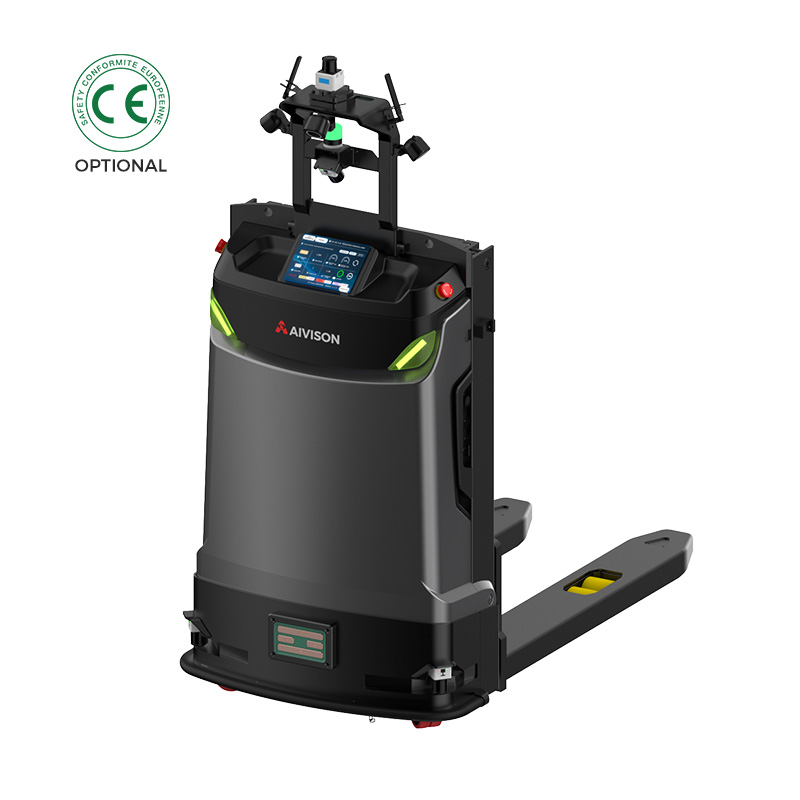
China Factory Automated Mobile Robot SLAM Lifting Wholesale AGV Chassis Vehicle
An OEM-ready SLAM lifting AGV chassis for integrators. Specify jacking, roller, or custom top modules while keeping a proven chassis, lidar layout, and fleet software interface.
- Integrator-friendly platform
- Custom top module interface
- Service and spare-part commonality

Hot Selling Logistics Navigation Detector Sensor Lidar Manufacturers Direct Sales
A direct-sales logistics navigation detector and lidar sensor for AGV/AMR builders and retrofit projects. Useful when navigation reliability, spare-part lead time, and sensor-level traceability matter.
- Navigation and obstacle detection
- Direct-sales component supply
- Retrofit and new-build applications
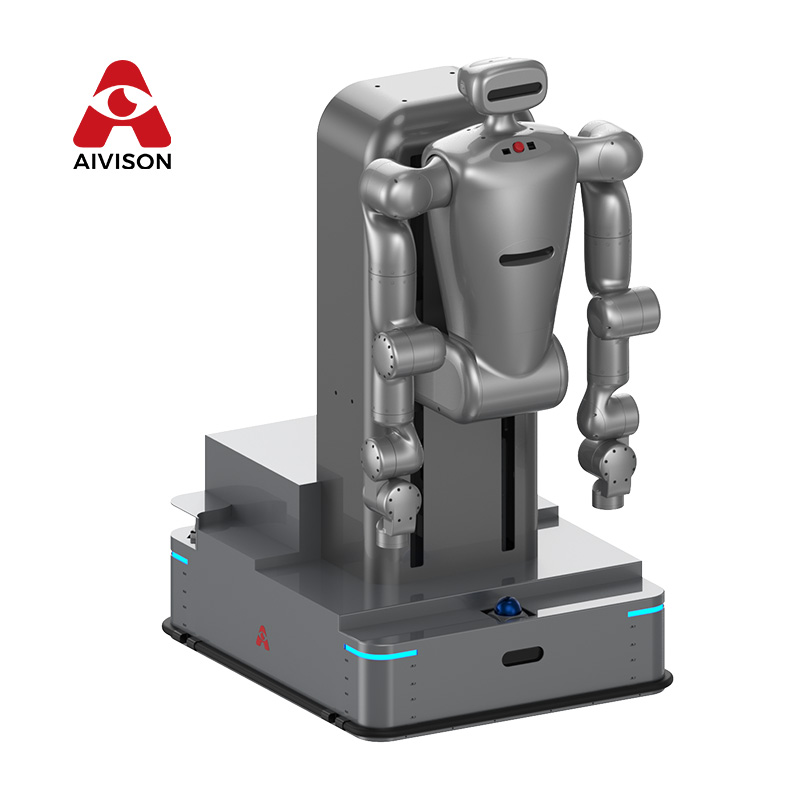
Omnidirectional Mobile Manipulator AMR Dual 7-DOF Arms ±0.03 mm Repeatability Laser SLAM Humanoid Robot Base
An omnidirectional mobile manipulator with dual 7-DOF arms and laser SLAM. The ±0.03 mm repeatability target suits precision assembly, machine tending, and lab automation where mobile positioning alone is not enough.
- Dual 7-DOF arm configuration
- Omnidirectional mobile base
- Composite robotics for precise placement

Humanoid Robot Chassis Dual 7-DOF Arms Laser SLAM Omnidirectional Navigation ROS2 Open Platform AMR
A humanoid robot chassis with dual 7-DOF arms, laser SLAM, and a ROS2 open platform. It gives research and advanced manufacturing teams an omnidirectional base without starting from a blank sheet.
- ROS2 open platform
- Laser SLAM navigation
- Research and advanced automation base
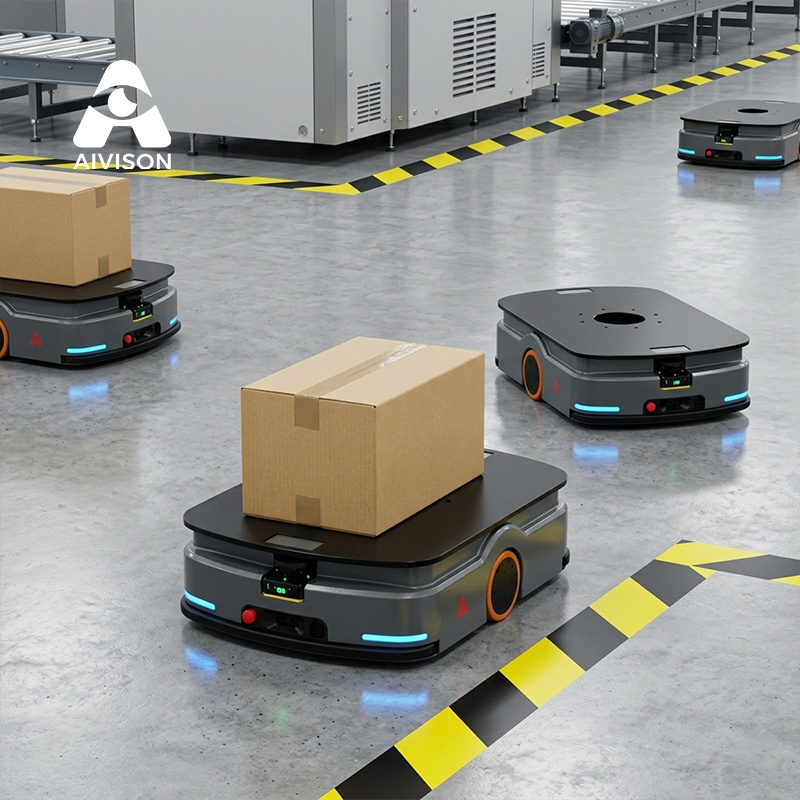
Autonomous Mobile AMR Robot 300kg Payload Laser Guided AGV for Carry Goods in Factory
A 300 kg payload laser-guided AMR for narrow aisles, light pallets, and repetitive factory delivery. It is a practical entry point when full-size forklifts are too large or utilization is too low.
- Compact factory AMR
- Laser-guided navigation
- Light material and pallet handling
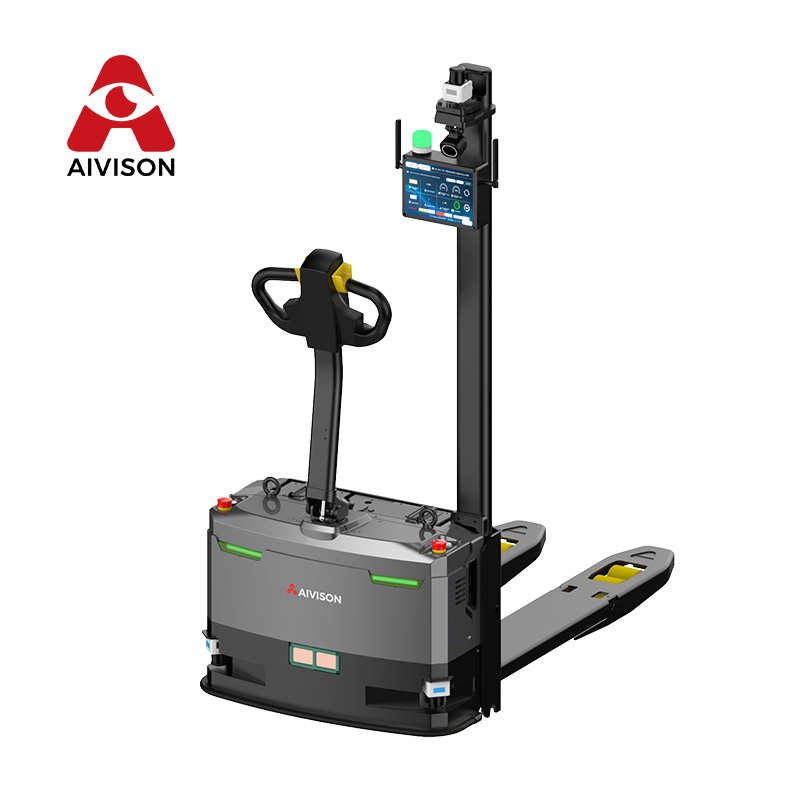
Aivison AGV Forklift High Quality Industrial Unmanned Pallet Forklift
An industrial unmanned pallet forklift built for repetitive pallet handling and high-duty cycles. Camera-assisted fork entry and SLAM navigation reduce dependence on floor infrastructure.
- Unmanned pallet forklift
- Camera-assisted fork entry
- High-duty industrial handling
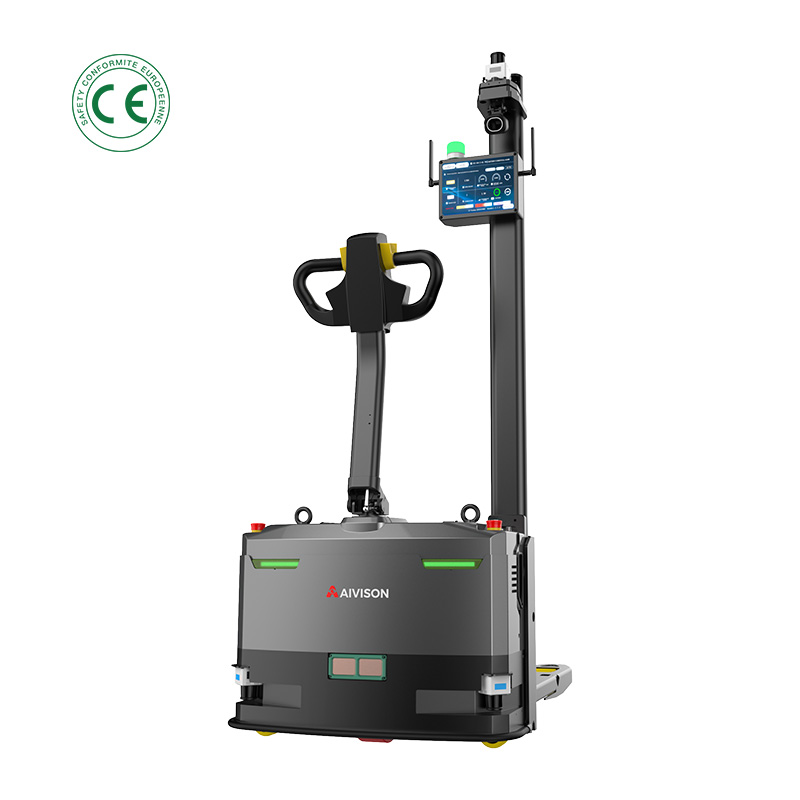
AIVISON CE Laser SLAM Navigation AGV 1500kg Warehouse Lifting Operations
A 1500 kg CE laser SLAM navigation AGV for warehouse lifting operations. It balances payload, route flexibility, and factory integration for medium-duty pallet transport.
- 1500 kg warehouse lifting
- Laser SLAM navigation
- CE-focused warehouse platform
Need a shortlist in 48 hours? Send your pallet drawing, aisle width, docking tolerance, and throughput target.
Contact UsPallet Robot Buying Is Moving From “Can It Drive?” to “Can It Run the Operation?”
Across recent RFQs and integrator projects, five evaluation weights decide whether a pilot becomes a rollout. The percentages below are an illustrative planning model—not a market forecast—and should be adapted to your labor, safety, and uptime assumptions.
Why the weighting matters
A low robot price can be outweighed by weak service, poor energy performance, or a closed fleet protocol. Buyers are increasingly asking for energy per mission, brake and wheel life, battery cycle cost, spare-parts pricing, and a documented software roadmap before issuing a purchase order.
TCO replaces purchase price
Energy consumption per mission, brake life, wheel life, battery cycle cost, and spare-parts pricing are now part of the business case. A 10–20% lower purchase price can disappear in two years if uptime and energy performance are weaker.
Safety evidence enters the RFQ
EHS teams now request stop-distance calculations, scanner coverage, PL d claims, and ISO 3691-4 test reports before a site visit. CE scope must match the exact robot model and top module.
Interoperability and VDA 5050
Fleets are rarely single-brand. API documentation, VDA 5050 support, and Wi-Fi traffic planning are becoming procurement requirements rather than integration afterthoughts.
Modular customization
Integrators want a proven chassis with configurable jacking, roller, fork, or arm modules. One-off engineering slows delivery and complicates spare parts.
Service and spare parts
Global buyers ask for local service partners, remote diagnostics, and a documented spare-parts list. Response time is often more important than a longer warranty headline.
Energy strategy
Opportunity charging, LFP battery safety, charger interoperability, and peak shaving are moving into the business case. Robots should not create a new energy bottleneck.
Data and cybersecurity
Audit trails, role-based access, and network segmentation are now part of factory IT review. A robot that cannot be updated securely becomes a liability.
Supply-chain resilience
Dual sourcing, factory audits, and shorter component lead times are driving buyers to qualify manufacturers with visible assembly and test capability.
What the Next Generation of Pallet Transport Robots Will Do Differently
The direction is clear: less floor infrastructure, more perception, open fleet software, and safety engineered into the architecture. For buyers, the practical question is which capability creates measurable uptime—and which is only a demonstration feature.
SLAM + 3D lidar + vision
Natural-feature SLAM reduces infrastructure, while 3D lidar and vision improve pallet detection, fork entry, and dynamic obstacle classification. The result is faster commissioning and fewer false stops.
Semantic mapping and edge AI
Robots will understand “receiving lane,” “charging zone,” or “forklift crossing” instead of only coordinates. Edge inference reduces dependence on cloud latency.
Composite and dual-arm mobility
Mobile manipulators combine a precise arm with an omnidirectional base. Expect more tasks that require both transport and repeatable placement, especially in semiconductor and medical assembly.
Fleet orchestration and open APIs
Fleet managers are becoming the real automation platform: traffic control, task prioritization, elevator integration, and KPI dashboards across mixed fleets.
Digital twin and simulation
Map data, route logic, and throughput scenarios can be tested before hardware arrives. This shortens site acceptance and reduces layout changes after commissioning.
Safety and cybersecurity by design
Safety functions and network security will be specified at the architecture stage, not patched after the first audit. Expect more PL d / Cat 3 designs and signed software updates.
Battery and charging evolution
LFP chemistry, opportunity charging, and charger-to-fleet communication reduce battery swapping and improve uptime. Buyers should request cycle-life and thermal test data.
Standardized top modules
Jacking, roller, conveyor, and arm interfaces will become more modular, allowing one chassis family to serve multiple process steps and reduce spare-part variety.
Match Navigation Accuracy to the Station, Not the Brochure
| Configuration | Typical accuracy | Floor infrastructure | Best-fit tasks | What to verify |
|---|---|---|---|---|
| Laser SLAM with natural features | ±5 mm | No tape, reflectors, or floor QR codes | Warehouse transfer, line-side delivery, changing layouts | Map size, dynamic obstacle test, re-localization behavior |
| SLAM + QR code camera | ±2 mm | QR labels only at docking stations | High-shelf storage, precision docking, wafer handling | QR maintenance plan, camera calibration, docking repeatability |
| Composite robot with 6-axis arm | ±0.05 mm | Station calibration and safety assessment | Semiconductor and medical device assembly | Repeatability definition, force limits, task cycle time, guarding |
Why a Manufacturer-Led Supplier Shortens the Path From RFQ to Uptime
The strongest supplier is not the one with the longest brochure. It is the one that can connect chassis engineering, top-module design, safety documentation, fleet software, and after-sales support without passing risk between subcontractors.
About ten years of AGV engineering
Shenzhen-based R&D and manufacturing experience across jacking robots, smart forklifts, pallet AMRs, and charging docks—built around real production-line constraints rather than laboratory demos.
Complete platform portfolio
One supplier for jacking robots, smart forklifts, pallet AMRs, composite robots, and intelligent charging docks reduces integration risk and spare-part fragmentation.
Practical precision ladder
±5 mm laser SLAM without floor infrastructure; ±2 mm with QR where docking demands it; ±0.05 mm repeatability for composite arm robots. Buyers can specify only the accuracy the station actually needs.
Manufacturer-level customization
Chassis, payload, and top modules—jacking units, roller conveyors, forklift forks, and 6-axis arms—engineered around your process instead of forcing a standard fit.
Quality protocol before shipment
Multi-stage intelligent inspection and thousands of operational stress tests target near-zero failure rates. The acceptance conversation starts with test evidence, not a promise.
Fleet software and charging
Intelligent scheduling over indoor Wi-Fi coordinates multi-robot dispatch, traffic control, and automatic charging through compatible smart charging docks.
Shenzhen Marnix Intelligent Technology Co., Ltd.
Based in Shenzhen, Guangdong, the company builds laser SLAM AMRs, jacking robots, smart forklifts, composite mobile robots, and intelligent charging docks. Its stated engineering targets include ±5 mm natural-feature SLAM, ±2 mm QR-assisted docking, and ±0.05 mm composite repeatability. The customer base spans end users and system integrators, with verified supplier records, credit data, and transaction history available for review.
How to Evaluate a CE Certified Pallet Transport Robot Factory in Six Steps
The fastest way to separate a real factory from a trading layer is to ask for evidence that only an engineering team can produce: tolerance stack-ups, safety architecture, calibration records, and a model-specific compliance file.
Define the load and interface
Record maximum weight, pallet or rack footprint, center of gravity, and whether the robot must lift, tow, fork, or transfer. Confirm the top module before discussing navigation.
Map the route and traffic
Check aisle widths, doorways, slopes, elevator or lift transfer points, and mixed human/forklift traffic. A ±5 mm robot still needs a physically navigable route.
Set the accuracy tier
Use ±5 mm for general transfer, ±2 mm for precision docking, and ±0.05 mm only where a manipulator must place a part. Over-specifying accuracy adds cost without operational benefit.
Calculate fleet size
Model missions per hour, average cycle time, charging window, and peak surge. Base fleet size on the 85th-percentile peak, not an average day.
Request the compliance pack
Ask for the EU Declaration of Conformity, bill of standards, risk assessment, safety function description, battery and charger certificates, and CE scope by model.
Run an acceptance test
Agree on factory and site acceptance tests: docking repeatability, obstacle stop distance, fork entry success rate, charging cycle, fleet handover under load, and emergency-stop behavior.
A Practical Supplier Scorecard
| Evaluation area | Evidence to request | Red flag |
|---|---|---|
| CE scope and technical file | EU Declaration of Conformity with model list, standards, authorized representative, and risk assessment | Generic certificate with no model-level scope |
| Safety validation | ISO 3691-4 test report, PL d architecture, stop-distance calculation, scanner coverage plan | No hazard analysis or safety function description |
| Navigation performance | Docking repeatability test, map-size data, dynamic obstacle test, re-localization behavior | Brochure-only accuracy numbers |
| Manufacturing capability | Factory audit report, assembly/test records, calibration logs, top-module engineering drawings | No traceable manufacturing or test capability |
| Service and spare parts | Spare-parts list with pricing, response SLA, training plan, remote diagnostics access | No local support plan or unclear part lead times |
| Fleet software | API documentation, VDA 5050 support, Wi-Fi planning guide, cybersecurity update process | Closed protocol only; no upgrade path |
| Total cost of ownership | Energy per mission, maintenance interval, uptime reference, warranty terms, end-of-life plan | Price-only quote with no operating assumptions |
Build the TCO model before the price negotiation
For a multi-shift pallet transport project, purchase price is only one line. The operating model below is illustrative; replace each percentage with your own energy tariff, maintenance contract, and downtime cost.
A lower purchase price can lose on energy, maintenance, or downtime. Ask every supplier to use the same operating assumptions so the comparison is defensible.
Pallet Transport Robot Procurement Questions, Answered Directly
These are the questions that repeatedly decide whether a project moves from inquiry to site survey. If your case is not covered, send the load, layout, and throughput data through the inquiry button.
Is a CE certificate enough to approve a pallet transport robot?
No. CE marking is a declaration that the product meets applicable EU legislation, supported by a technical file and risk assessment. Ask for the EU Declaration of Conformity, the exact standards applied, the model and top-module scope, safety function performance, and the site integration assumptions. For driverless trucks, ISO 3691-4 is a key reference. The buyer must still validate the complete system—robot, top module, route, traffic, and charger—in the actual site.
Which standards should a CE-certified autonomous forklift reference?
Depending on the configuration, expect the Machinery Directive 2006/42/EC and the EU Machinery Regulation 2023/1230 from January 2027, EMC Directive 2014/30/EU, ISO 3691-4:2023 for driverless industrial trucks, ISO 13849-1 for safety-related control systems, IEC 61496 for safety laser scanners, and EN 1175 for electrical requirements. Battery and charger standards may include UN 38.3 for transport and IEC 62619 for industrial battery safety. The exact list must match the product and market.
What is the difference between ±5 mm, ±2 mm, and ±0.05 mm?
±5 mm is the natural-feature laser SLAM tier and is usually sufficient for pallet transfer, line-side delivery, and warehouse moves. ±2 mm typically uses a QR code camera at the docking station and suits high-shelf storage, precision docking, or wafer handling. ±0.05 mm is a repeatability claim for a composite robot with a 6-axis arm and is relevant only when the robot must place a part into a fixture. Do not buy ±0.05 mm for a task that only needs ±5 mm.
Do pallet transport robots need floor tape, reflectors, or QR codes?
Not for standard laser SLAM. Natural-feature SLAM maps walls, pillars, and fixed equipment, so no auxiliary tracks or reflectors are required. QR labels are added only at stations that need ±2 mm docking precision. This reduces floor rework, but it does not remove the need for good Wi-Fi coverage, clean maps, and a route survey.
How many robots do I need for a three-shift operation?
Use a simple model: required fleet = peak missions per hour × average cycle time ÷ available minutes per hour, then add a redundancy factor for charging, maintenance, and traffic congestion. For a three-shift operation, also check battery cycle life, opportunity-charging windows, and the cost of a single point of failure. A pilot with one or two robots is usually the fastest way to calibrate the model.
Can a mixed fleet of forklifts, jacking robots, and AMRs work together?
Yes, if the fleet manager supports the required interfaces. Look for VDA 5050, documented APIs, traffic-zone configuration, elevator or door integration, and a clear task-priority model. Mixed fleets are common in brownfield sites; the procurement question is not whether the robots can coexist, but whether the software can coordinate them without manual traffic control.
What should a factory acceptance test include?
Test the actual duty cycle, not just a straight-line demo. Include docking repeatability at the real pallet or rack interface, obstacle stop distance and restart behavior, fork entry success rate, charging cycle and fault recovery, fleet handover under load, and emergency-stop validation. Record the results against the agreed acceptance criteria and keep them in the project file.
How do I compare a factory-direct supplier with a trading company?
Ask for evidence that cannot be copied from a brochure: factory audit report, assembly and test photos, calibration records, model-level CE scope, spare-parts list, and engineering contact details. A trading company can be useful for commercial convenience, but a manufacturer should be able to explain the safety architecture, tolerance stack-up, and top-module interface. For custom projects, manufacturer-level engineering usually reduces integration risk.
Send Your Load, Layout, and Throughput. Get a Factory-Backed Robot Recommendation.
Share the pallet weight, aisle width, docking tolerance, shift pattern, Wi-Fi coverage, and target go-live date. Our engineering team will map the requirement to the right platform—laser SLAM AMR, autonomous forklift, jacking robot, or composite mobile manipulator—and return a configuration with the relevant CE and safety documentation.
Please include: pallet or rack drawing, maximum payload, aisle width, docking accuracy, operating hours, and any existing fleet software.