0%

In 2026, choosing an Automated Guided Vehicle (AGV) means matching a machine to real work. Start with the load: note its weight, dimensions, pickup points, and how often it moves. Then map the route. A narrow aisle, uneven floor joint, or busy crossing can change which vehicle is suitable. Small details matter. Check whether the AGV can turn, stop, and transfer loads safely at each station, not just travel on an open test floor.

Compare guidance options, such as magnetic markers, laser navigation, or camera-based systems, against your facility’s layout and expected changes. Ask suppliers for documented payload limits, operating conditions, charging requirements, and integration details for your warehouse software and equipment. Those specifications need to fit your site, not just a brochure. Plan for people sharing work areas, maintenance access, spare parts, and the response time available when a vehicle is out of service. A low purchase price may not reflect the full cost of ownership.

Before committing, run a route trial with representative loads and normal traffic. Record cycle times, interruptions, manual interventions, and charging behavior. A tidy demonstration can miss ordinary problems; real shifts are less predictable. No single AGV suits every operation, and early estimates can be wrong. Use measured results, clear acceptance criteria, and a review of vendor support to make a grounded choice. The right decision is the one your team can operate reliably as workflows change.
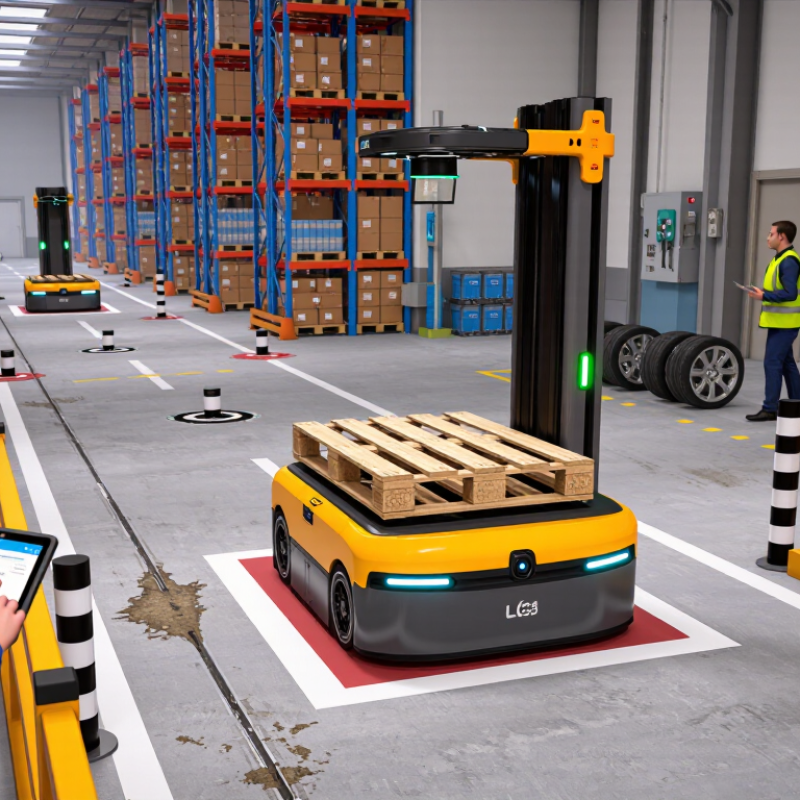
How to Choose an Automated Guided Vehicle in 2026

Understanding Automated Guided Vehicles and Their Capabilities

An automated guided vehicle (AGV) is a driverless vehicle that moves materials along planned routes. It may follow floor markings, magnetic tape, or mapped paths. An autonomous mobile robot (AMR), by contrast, can use onboard sensors to adjust its route around obstacles. That distinction matters.

IFR’s World Robotics 2024 report recorded about 113,000 professional service robots sold for transport and logistics in 2023, a 35% increase year over year. This category includes more than AGVs, so the figure signals demand, not a guaranteed fit.

Match the vehicle’s capabilities to the actual job: payload, travel distance, floor condition, aisle width, and traffic around people. A loaded cart crossing a polished floor needs different handling from a vehicle carrying parts over joints and ramps.

Check how it stops, detects obstacles, and resumes after a blocked route. Small details matter. A route map can look perfect on paper, while a busy shift brings parked carts and unexpected detours. Real sites are rarely so tidy.

Compare cycle times under realistic traffic, not just an empty-aisle demonstration, and confirm that charging and maintenance fit daily operations. A faster vehicle may still cause delays if its turning radius or load-transfer height does not suit the workflow.

Assessing Material-Handling Needs and Operating Conditions

Selecting an automated guided vehicle starts with the load, not the vehicle. Record each item’s weight, dimensions, pickup height, and delivery point. A 300-kilogram load on a compact pallet behaves differently from a long, uneven machine part. Note how often loads move and whether demand peaks at shift changes. Small details matter.

Walk the actual route during a busy period. Measure aisle widths, turning space, floor joints, slopes, and doorway clearances. A route that looks open on a plan may narrow beside a parked cart. Check for dust, moisture, temperature changes, and reflective surfaces that can affect navigation. People move unpredictably. Include pedestrians, forklifts, and temporary obstacles in the assessment, rather than treating the route as empty.

Then compare the vehicle’s rated payload and turning radius with those measured conditions. Estimate travel cycles, charging windows, and time spent waiting at handoff points. Confirm how it will communicate with doors, lifts, and existing control systems. Safety sensors need enough room to detect and respond to obstacles; crowded intersections may require route changes. Pilot the proposed setup with representative loads and record delays, stops, and operator feedback. Early calculations can be wrong. That is useful to discover before expanding the fleet. A short trial may expose a bottleneck that a spreadsheet misses.

Comparing Navigation Systems, Payloads, and Safety Features

How to Choose an Automated Guided Vehicle in 2026

Comparing Navigation Systems, Payloads, and Safety Features

Navigation determines how reliably an automated guided vehicle moves through real workspaces. Magnetic tape and floor markers offer predictable routes, but changes require physical updates. LiDAR-based mapping can adapt to shifting layouts, though pallets, reflective surfaces, and busy crossings still challenge detection. The International Federation of Robotics’ World Robotics 2024 report recorded about 113,000 professional service robots for transport and logistics in 2023. That growth makes careful site testing more important, not less. Test the vehicle during a normal shift, with people and forklifts moving nearby.

Payload figures need context. A vehicle rated for 1,000 kilograms may handle less safely when its load sits high or off-centre. Check load dimensions, turning space, floor joints, ramp gradients, and braking distance with the actual cart. Small details matter. A loose pallet can change the route’s risk profile. I would not choose from a specification sheet alone; it rarely captures the awkward corner beside a busy packing station.

Safety features should match the route and traffic, not just the purchase checklist. Look for obstacle detection, emergency stops, clear warning signals, and controlled speed near people. Review ISO 3691-4:2020 as a reference for driverless industrial truck safety, alongside a site-specific risk assessment. More sensors do not automatically mean safer operation. Confirm detection zones under real lighting, test stopping distances with representative loads, and document who can pause or restart the vehicle. One missed blind spot is enough.

How to Choose an Automated Guided Vehicle in 2026

Typical payload ranges by vehicle class. Actual capacities vary by model and configuration.

Small platform vehicles commonly handle about 100–500 kg; pallet movers 500–1,500 kg; forklift-style vehicles 1,000–3,000 kg; and heavy-load vehicles 5,000–30,000 kg. For navigation, magnetic tape or floor markers suit stable routes, while laser natural-feature navigation is generally easier to adapt when layouts change. Compare payload at the required lift height and load center, and verify protective fields, emergency stops, warning devices, and applicable ISO 3691-4 safety requirements for the specific installation.

Evaluating Integration, Total Cost, and Supplier Support

How to Choose an Automated Guided Vehicle in 2026

An automated guided vehicle must fit the workflow around it, not just move a load from A to B. Check how it will exchange tasks with your warehouse or manufacturing software. Confirm that routes, traffic rules, doors, lifts, and charging points work with existing equipment. A site walk can reveal tight turns or uneven floor joints that a presentation misses. Small details matter. Ask for a pilot using representative loads and shifts. Track delivery time, blocked routes, and manual interventions.

Compare total cost over the vehicle’s expected working life, rather than purchase price alone. Include installation, software, operator training, batteries, charging equipment, maintenance, and production downtime during rollout. Request clear assumptions behind any savings estimate. A spreadsheet can still hide messy realities, such as seasonal peaks or a layout that changes next year. That deserves a second look. Check which routine tasks your staff can handle and which require specialist service.

Supplier support affects uptime long after installation. Ask who responds to faults, how quickly, and whether technicians can reach your site. Review support hours, spare-parts availability, software update procedures, and escalation steps. Request practical training and readable maintenance documentation. During a trial, note whether the supplier records issues and follows through with specific fixes. A polished demo is useful, but dependable support is easier to judge when something goes wrong.

Validating the Choice Through Testing and Deployment Planning

How to Choose an Automated Guided Vehicle in 2026

A sound choice is proven on the floor, not just on a specification sheet. Test the vehicle with representative loads, real aisle widths, and typical traffic. Record travel time, stopping distance, and task completion across several shifts. Watch how it handles floor joints, tight turns, and temporary obstructions. Small details matter. A route that works during a quiet demo may struggle near a busy packing station. One test will not reveal everything.

Tips: Use the heaviest routine load, not an idealized sample. Mark proposed routes with tape, then check turning clearance. Include operators and maintenance staff in trials; they may spot awkward handoffs or access problems early. Keep a simple issue log.

Before deployment, map how the vehicle will share space with people and existing equipment. Define pickup points, charging locations, and safe recovery steps for a stopped vehicle. Confirm that doors, lifts, and workstations respond reliably during repeated runs. Plan training around actual tasks, including what staff should do when a route is blocked. Set baseline measures before installation, such as completed moves per hour and manual interventions. Then compare results after a controlled rollout. Some estimates will be wrong; that is useful information, if the team revises routes and procedures rather than treating the first plan as fixed.

How to Choose an Automated Guided Vehicle in 2026 — Validating the Choice Through Testing and Deployment Planning

Planning example: The figures below describe an illustrative warehouse use case, not universal equipment specifications. Confirm requirements through site measurements, risk assessment, and trials with the intended load and route.

Decision dimension Example planning data How to validate Selection or deployment gate
Load and handling Pallet load: 800 kg. Example design allowance: 25% above the maximum expected load, giving a minimum rated payload of 1,000 kg. Weigh representative and maximum loads. Test pickup, travel, turning, and set-down with the actual pallet dimensions and load overhang. Reject any configuration that cannot safely handle the heaviest approved load and its center of gravity.
Route and cycle time Example route: 250 m one way. At a measured average travel speed of 1.0 m/s, a 500 m round trip takes about 8.3 minutes before pickup, set-down, and waiting time. Map the full route, including turns, crossings, doorways, and handoff points. Time repeated loaded and unloaded cycles during normal traffic. Use observed end-to-end cycle time—not maximum travel speed—in the capacity calculation.
Required throughput Illustrative demand: 20 delivery tasks per hour. If a validated cycle averages 8 minutes, one vehicle completes about 7.5 tasks per hour; three vehicles cover the nominal rate, before reserve capacity. Run a representative peak-hour workload and record completed tasks, queue time, blocked time, and manual interventions. Plan fleet size from measured cycle time and peak demand. Add capacity for variability, charging, and maintenance rather than sizing to the average alone.
Fleet capacity and congestion For the example above, three vehicles provide 22.5 tasks per hour only if each consistently sustains a 7.5-task-per-hour rate; actual output may be lower when routes interact. Simulate and pilot simultaneous traffic at intersections, shared aisles, and pickup stations. Measure vehicle waits and aisle blockage. Increase fleet capacity, change traffic rules, or redesign routes if congestion prevents the required peak throughput.
Floor and environment Record floor joints, slopes, surface condition, aisle width, clearances, lighting, temperature, and any wet or dusty areas at the proposed site. Survey the route and test the vehicle with its maximum load over the least favorable floor sections and at the narrowest clearances. Confirm that traction, stability, turning space, and ground clearance suit the measured site conditions.
Safety and people sharing the route Document pedestrian crossings, blind corners, doors, emergency exits, and interactions with forklifts or other moving equipment. Conduct a site-specific risk assessment. Test obstacle detection, stopping behavior, warning signals, speed zones, and recovery after a protective stop. Do not release the system until protective functions and traffic controls are validated for the actual layout and operating procedures.
Pickup and delivery accuracy Define the required handoff position and tolerance for each station; specify whether loads are placed on a conveyor, rack, cart, or floor location. Repeat pickup and set-down trials using representative pallets and station conditions. Record misalignment, failed transfers, and manual corrections. Confirm that the transfer method and station design achieve the site's required placement accuracy without unsafe manual handling.
Charging and availability Document operating hours, shift pattern, expected task demand, and available charging windows. Determine energy use from a loaded pilot rather than a brochure estimate. Measure energy consumption across a representative shift, including travel, waiting, and handling. Test the planned charging approach during normal operations. Verify that charging time and location support the required operating schedule without creating traffic or availability bottlenecks.
Pilot acceptance Set site-approved targets before testing—for example, task completion rate, delivery accuracy, intervention frequency, and recovery time. Run a pilot across representative shifts and workloads. Log completed and failed tasks, stops, operator interventions, downtime, and safety events. Approve wider deployment only when agreed targets are met consistently and outstanding issues have named owners and resolution dates.
Integration and rollout List required interfaces, task triggers, traffic controls, charging areas, maintenance responsibilities, and operator training needs. Test end-to-end task creation, status reporting, exception handling, and recovery from communication or process interruptions. Deploy in stages: one route or process first, then expand after operational performance, training, and support procedures are verified.

FAQS

What should an automated guided vehicle fit into?

It should fit your workflow, routes, software, and existing equipment. A site walk can reveal tight turns or uneven floor joints.

How can we check software and route compatibility?

Confirm task exchange with warehouse or manufacturing software. Test doors, lifts, traffic rules, and charging points during repeated runs.

What should an AGV pilot measure?

Use representative loads and normal shifts. Track travel time, blocked routes, stopping distance, completed tasks, and manual interventions.

Which loads should we use in testing?

Test the heaviest routine load, not an idealized sample. That can expose handling issues early.

How should we compare vehicle costs?

Include installation, software, training, batteries, charging equipment, maintenance, and rollout downtime. Check the assumptions behind savings estimates.

What support should we expect from a supplier?

Ask who responds to faults, how quickly, and whether technicians can reach your site. Check support hours and spare-parts availability.

How can staff prepare for deployment?

Involve operators and maintenance staff in trials. Define pickup points, charging locations, and recovery steps for a stopped vehicle.

What should we do when test results differ from estimates?

Keep an issue log and compare results with baseline measures. Some estimates will be wrong; revise routes and procedures instead of treating the first plan as fixed.

Conclusion

Choosing an Automated Guided Vehicle in 2026 starts with understanding what these vehicles can do and how their capabilities match your material-handling tasks. Assess the loads you need to move, travel distances, traffic patterns, floor conditions, operating hours, and any space constraints. These details help clarify the required payload, vehicle size, and level of flexibility.

Next, compare navigation options and safety features in the context of your site, then consider how the vehicle will integrate with existing workflows and systems. Look beyond the purchase price to estimate total costs, including setup, maintenance, training, and ongoing support. Before committing, validate your choice through practical testing and a clear deployment plan. A careful evaluation helps ensure the vehicle can perform reliably, work safely alongside people and equipment, and support your operation as its needs change.

Charlotte

Charlotte

Charlotte is a marketing professional who brings a thoughtful, product-focused perspective to the company’s communications. With strong knowledge of the company’s offerings, she translates product features, practical applications, and customer considerations into clear, useful information. She......