Choosing among China’s leading Automatic Guided Vehicle manufacturers requires more than comparing brochures. Buyers should examine payload ratings, navigation methods, safety features, service coverage, and integration with warehouse software. A compact tugger moving bins along a marked aisle faces different demands from a heavy-load vehicle serving a busy factory floor.
Industry data shows why the category deserves attention. The International Federation of Robotics reported 541,302 industrial robots installed worldwide in 2023. That figure covers industrial robots broadly, not AGVs alone, so it should not be mistaken for an AGV sales total. MHI’s 2024 Annual Industry Report also found that 55% of surveyed supply-chain professionals planned to invest in robotics and automation within five years. Adoption is growing. But fit matters more than hype.
A useful perspective comes from Jeff Burnstein, president of the Association for Advancing Automation, who has emphasized evaluating automation by the operational problem it solves. For AGV buyers, that means asking practical questions: Can the vehicle handle narrow turns? How does it recover after a blocked route? Who supports it after installation? These details separate a working system from an impressive demonstration. Not every factory needs the same answer. This guide compares Chinese manufacturers through that lens, while recognizing that specifications and service quality should be verified directly with each supplier.
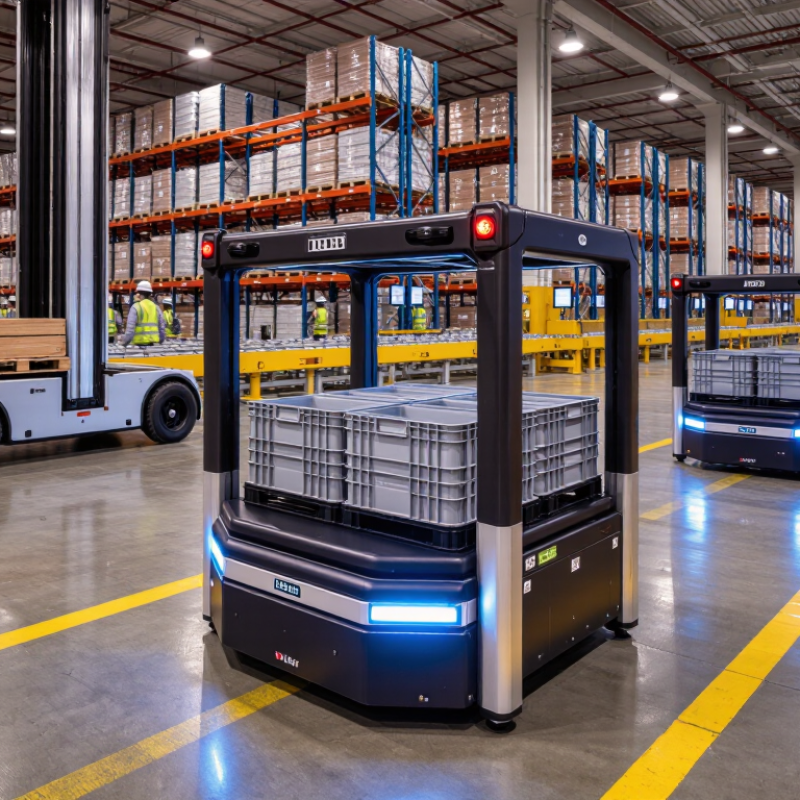
An estimated 113,000 transport robots were sold worldwide in 2022, highlighting growing interest in automated material handling. That figure is useful context, but it does not tell buyers which vehicle suits a particular site. AGVs commonly follow defined routes, using markers, wires, or mapped paths. AMRs can adjust routes around obstacles, depending on their sensors and software. In practice, product labels can overlap, so check how a vehicle navigates rather than relying on its name.
Tips: Walk the proposed route before comparing equipment. Note narrow aisles, floor joints, doorways, and busy crossings. Ask for a trial using representative loads and real shift patterns. Small details matter.
A capable system needs more than a robot. Check load capacity, stopping behavior, charging arrangements, fleet coordination, and integration with existing workflows. Request clear performance assumptions, including travel distance and expected traffic. A demonstration on an empty floor may look smooth; a crowded shift can reveal delays. I would also leave room for uncertainty: actual throughput often differs from early estimates. Choose a supplier that can explain limitations and support commissioning, not only showcase a polished vehicle.
Chinese AGV manufacturers offer several navigation options, but the right choice depends on the facility, not a feature list. Laser systems scan reflectors or surroundings to estimate a vehicle’s position. They suit changing routes, though dust, reflective surfaces, and blocked sightlines can affect readings. A clean floor helps.
Vision navigation uses cameras to identify landmarks or floor features. It can reduce the need for dedicated markers, but lighting changes and visual clutter deserve testing. A camera that works beside a bright loading bay may struggle under dim warehouse lighting.
QR-code guidance follows labels placed at measured points on the floor. It is straightforward to inspect, yet damaged or dirty codes can interrupt movement. Magnetic guidance uses embedded strips or floor tape, offering predictable paths but less routing flexibility. During supplier evaluations in China, buyers should ask for demonstrations on representative floors, with realistic loads and traffic. Measure repeatability, stopping accuracy, recovery time, and maintenance needs. One detail is easy to miss: a navigation system may perform well alone, then hesitate around people or crossing vehicles. No method is perfect; trial results can also change after layout updates.
China Best Automatic Guided Vehicle Manufacturers?
Compare Chinese AGV makers against your actual routes, loads, and shifts—not headline specifications. IFR’s World Robotics 2024 report recorded about 113,000 professional service robots sold for transportation and logistics in 2023, showing the scale of demand. But industry growth does not prove a particular vehicle will suit your site. Check rated payload with the real load and its center of gravity. Ask for loaded travel speed, turning radius, and performance on your floor’s ramps and joints.
Uptime needs evidence from comparable installations. Request operating hours, fault logs, recovery procedures, spare-part lead times, and local service response targets. A fast vehicle can still reduce throughput if it blocks narrow aisles or needs frequent charging. Compare total cost over several years, including fleet software, mapping, integration, batteries, maintenance, safety commissioning, and production lost during downtime. These costs are easy to underestimate; even a small integration delay can disrupt a shift.
Tips: Run a site trial with representative loads and peak-hour traffic. Record completed missions, charging pauses, and manual interventions. Compare cost per completed move, not just purchase price. And leave room for doubt: a short pilot rarely reveals every seasonal or maintenance issue.
Practical comparison criteria and indicative engineering ranges. Actual specifications vary by vehicle design, site conditions, load, and configuration.
| Comparison Dimension | Indicative Range or Measure | What to Check with Each Maker |
|---|---|---|
| Rated payload | Light-duty units commonly handle about 100–500 kg; heavier industrial units may be rated from 500 kg to several tonnes. | Confirm the rated load at the required load center, lift height, floor condition, and travel speed—not just the maximum headline rating. |
| Travel speed | Many indoor industrial AGVs operate in the approximate range of 0.5–1.5 m/s; configured speed may be lower in shared or restricted areas. | Compare loaded and unloaded speeds, acceleration, turning behavior, and speed limits in pedestrian zones. |
| Navigation and positioning | Performance depends on the navigation method and environment; vendors should state repeatability and operating limits for the proposed setup. | Request a site test covering aisle width, floor markings or reflectors, changing lighting, ramps, intersections, and required docking accuracy. |
| Battery runtime and charging | Runtime is workload-dependent; battery capacity, duty cycle, payload, route length, and charging strategy determine operating time. | Compare usable runtime per shift, charging time, opportunity-charging support, battery replacement cost, and expected battery life. |
| Uptime and availability | There is no single universal AGV uptime figure. Availability should be calculated from agreed operating hours and recorded downtime categories. | Set an acceptance-test period and define whether downtime includes charging, blocked routes, faults, maintenance, and customer-caused stoppages. |
| Fleet management and integration | Required capacity depends on the number of vehicles, traffic layout, task rate, and integration architecture. | Verify multi-vehicle traffic control, dispatch rules, elevator and door interfaces, and compatibility with WMS, MES, or ERP systems. |
| Safety and compliance | Requirements depend on the application and destination market; risk assessment and applicable local standards are essential. | Request safety documentation, protective-device details, emergency-stop behavior, risk-assessment records, and evidence for applicable standards. |
| Total cost of ownership | Compare the full lifecycle cost rather than purchase price alone; cost depends on fleet size, shifts, service terms, and site changes. | Include vehicles, software, installation, infrastructure, integration, training, spare parts, batteries, maintenance, upgrades, and support response. |
| Service and spare parts | Support capability varies by supplier and service location; response times should be contractually defined. | Check local technician coverage, remote diagnostics, spare-parts availability, warranty exclusions, and escalation procedures. |
Comparison note: The ranges above are general planning references, not guaranteed specifications or a ranking of manufacturers. Compare quotations using the same payload, route, operating schedule, safety requirements, and acceptance-test conditions.
When comparing automatic guided vehicle manufacturers, examine how clearly they address ISO 3691-4:2020. This standard sets safety requirements and verification methods for driverless industrial trucks and their systems. It covers more than the vehicle itself. That distinction matters.
A suitable assessment considers the truck, its protective devices, and the environment where it will operate. Picture a loaded vehicle approaching a pedestrian crossing beside a blind rack corner. Does it detect people reliably, slow down, and stop within a safe distance? The answers depend on factors such as load, speed, floor condition, and sensor placement. A risk assessment should account for these real operating conditions, not only a clean demonstration area.
Ask manufacturers for test records, safety-function details, operating instructions, and guidance for commissioning. Then compare that evidence with your site layout and traffic patterns. ISO compliance alone does not guarantee safety in every facility; installation and ongoing operation matter too. Even a well-designed system can face unexpected behavior when routes change or floor markings fade. It is easy to overlook these small changes. Review them. A practical evaluation may reveal gaps that a checklist misses, and that is worth admitting before deployment.
An illustrative sequence for evaluating driverless industrial truck safety
The bars show the order of a practical safety review: define the application, assess risks, select protective measures, verify safety functions, and document results. This is an overview—not a numerical ISO benchmark, compliance score, or substitute for the standard’s requirements.
Chinese AGV makers now offer more than simple point-to-point carts. Their portfolios often include compact shelf-moving robots, pallet transporters, autonomous forklifts, and fleet-management software. Some emphasize rapid warehouse deployment; others focus on dense storage, machine vision, or coordinating mixed robot fleets. The differences matter on a real floor: aisle width, pallet condition, Wi-Fi coverage, and human traffic can change performance.
Industry figures provide context, not a direct ranking. The International Federation of Robotics’ World Robotics 2024 report recorded 276,288 industrial robot installations in China during 2023, about 51% of the global total. That figure covers industrial robots broadly, not AGVs alone. It signals a mature automation ecosystem, but buyers should still request site-specific results, safety documentation, and references from comparable facilities. A polished demo is not enough.
Tips: Ask vendors to test a full shift with your actual loads and routes. Track delivery accuracy, blocked-path recovery, and battery downtime. Small details expose weaknesses. No navigation system is flawless, and published performance claims may not reflect your warehouse’s layout.
AGVs usually follow defined routes, such as floor markers or mapped paths. AMRs can adjust around obstacles using sensors and software. Labels can overlap, so check how each vehicle navigates.
An estimated 113,000 transport robots were sold. That figure shows growing interest, but it cannot tell you which vehicle fits your site.
Walk the planned route. Note narrow aisles, floor joints, doorways, and busy crossings. Small details matter.
Use representative loads and normal shift patterns. Test crowded routes, not only an empty floor. A polished demonstration can hide delays.
Check load capacity, stopping behavior, charging, fleet coordination, and workflow integration. Ask for the assumptions behind expected performance.
It sets safety requirements and verification methods for driverless industrial trucks and their systems. Assessment should include the vehicle, protective devices, and operating environment.
Consider a loaded vehicle approaching a pedestrian crossing near a blind rack corner. Ask whether it detects people, slows down, and stops safely. Conditions matter.
No. Site layout, installation, and ongoing operation also matter. Faded markings or changed routes can affect performance. I would review these risks regularly.
Automatic Guided Vehicle (AGV) technology is becoming an important part of modern material handling, with approximately 113,000 transport robots sold worldwide in 2022. Chinese AGVs can navigate using laser systems, cameras and vision software, QR codes, or magnetic guidance. Each approach suits different environments, so buyers should consider route flexibility, facility conditions, and the level of infrastructure required before choosing a system.
Comparing AGV makers involves more than looking at the purchase price. Payload capacity, travel speed, operating uptime, service support, and total cost of ownership all affect long-term value. Safety is equally important: ISO 3691-4:2020 provides benchmarks for driverless industrial trucks, including guidance relevant to safe operation. A careful assessment of performance, integration needs, and safety provisions can help organizations select an AGV solution suited to their workflows.